
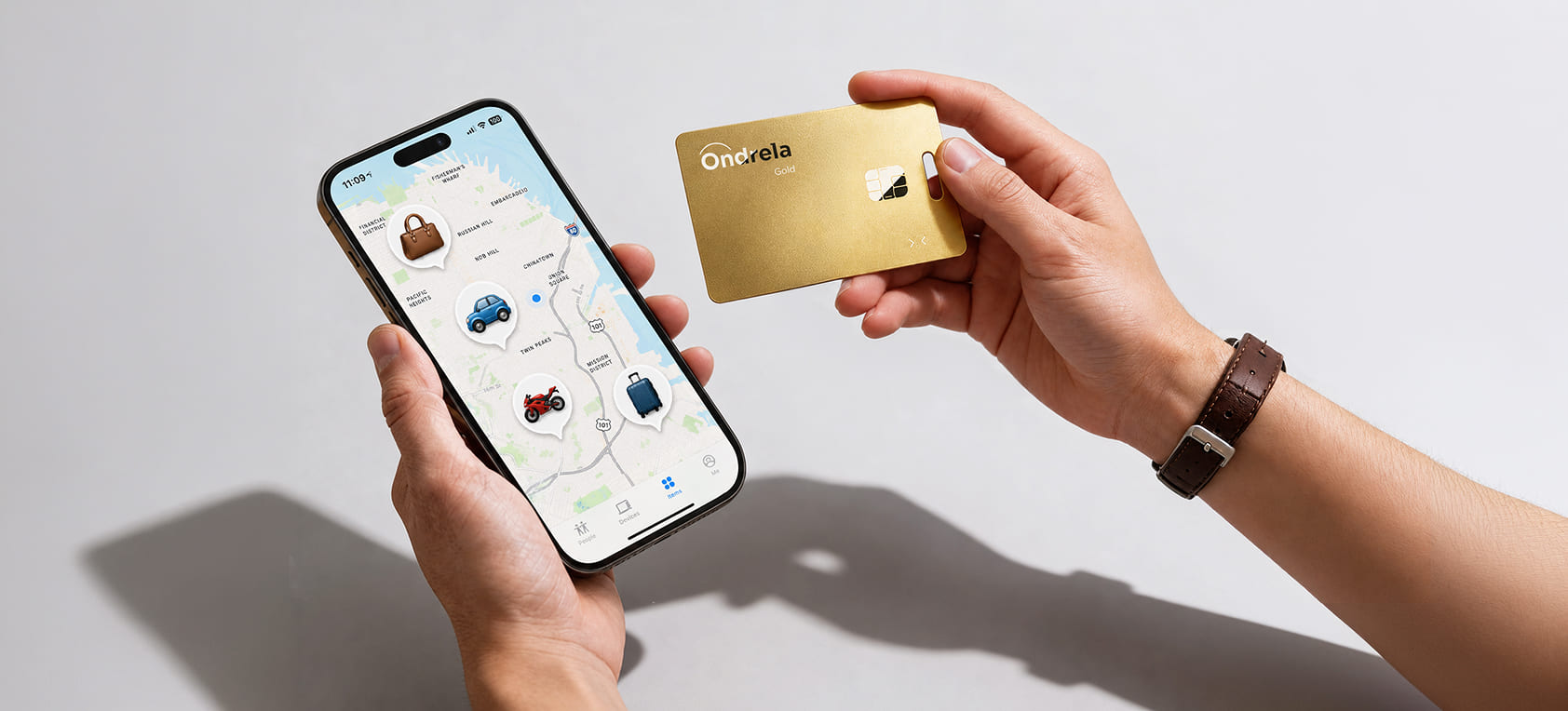
Ondrela Review 2026: Does the Gold Tracker Card Really Keep Your Wallet, Keys and Luggage Findable? Setup, Real-World Test, Price & Honest Verdict
It always happens at the worst possible moment: the wallet is still on the café table, the passport holder has slipped between the seats of a taxi, the suitcase is somewhere between two airports. Ondrela (searched for as “Ondrela tracker”, “Ondrela card”, “Ondrela Gold” or “Ondrela smart tracker”, and often misspelled as “Ondrella card”, “Ondela tracker” or “Ondero card”) wants to take the panic out of that moment with a tracker in credit-card format: a 1.7 mm thin, gold-colored card that slides into any wallet slot, connects to the tracking app that is already on your phone – Apple Find My on the iPhone or Google Find Hub on Android – alerts you when you leave it behind and rings on command. According to the vendor, one charge lasts around six months, and the card recharges wirelessly. No extra app, no SIM card, no monthly fees. For this Ondrela review we carried four cards for four weeks with an iPhone and two Android phones – in a wallet, on a key ring, in a suitcase and on a commuter bike. Below you’ll find how setup, ring volume, map updates in the city and the countryside, battery and charging performed, what the official checkout really charges – and what a Bluetooth crowd-network tracker does brilliantly compared with a GPS tracker.
- 🏆 Our verdict: Ondrela Gold Tracker Card – 8.4/10, very good. A Bluetooth tracker in credit-card format (1.7 mm thin) that works with Apple Find My (iPhone) or Google Find Hub (Android) without an extra app or account; built-in ring, left-behind alerts, a six-month battery and wireless charging according to the vendor; one-time purchase with no monthly fees; 60-day return policy.
- Strengths: Genuinely fits into a card slot where a coin-shaped tracker leaves a bulge; setup took under two minutes per card on both platforms; location updates came in reliably wherever people with phones were around – café, subway, train station, airport; the left-behind alert saved a forgotten wallet twice during our test; rechargeable instead of disposable; looks like a premium bank card, not like a gadget; from €24.99 per card in the 4-pack.
- To be honest: Ondrela is a Bluetooth finder that uses the phones around it, not a GPS tracker – superb in busy places, fewer updates in the countryside. One card works with one ecosystem at a time (Apple or Google). There is no directional arrow (ultra-wideband); close by, you find the card by sound, and the ring is quieter in noisy places. Bluetooth version, range and an IP rating aren’t published. “4.4/5” and “19,314+ customers” are vendor figures. Delivery from the EU takes 8–12 business days to the US and UK, 10–14 to Australia and 12–18 to Canada.
- Price (official checkout, October 2026, shown in euros for a German delivery address): 1 card €44.99, 2 cards €69.98 (€34.99 each), 3 cards €89.97 (€29.99 each), 4 cards €99.96 (€24.99 each, “Most popular”) – plus €4.95 standard shipping. One-time purchase, no subscription. The checkout shows prices in your local currency. Only available from the official shop.
Ondrela at a glance: product, fact sheet, verdict
|
🏆 Verdict: very good
 Ondrela Gold Tracker Card★★★★☆
Score 8.4/10 · very good
Price: from €24.99 per card
1× €44.99 · 2× €69.98 · 3× €89.97 · 4× €99.96 plus shipping |
Fact sheet according to the vendor
|
Prices as shown in the official checkout for a delivery address in Germany (euros, excluding shipping), October 2026; the shop displays prices in the currency of your location. Discount percentages are vendor claims.
- What is the Ondrela tracker card – and why a card instead of a tag?
- Lost wallet, missing suitcase: what a tracker card can and can’t do
- Ondrela smart tracker technology: Find My, Find Hub, ring and battery
- Ondrela review: how we tested
- The Ondrela card in practice: wallet, keys, luggage and bike
- What the Ondrela tracker can’t do – an honest list
- Our rating in detail
- Ondrela vs. AirTag, other wallet tracker cards and GPS trackers
- Setup step by step: iPhone and Android
- Who the Ondrela card is for – and who should skip it
- Ondrela reviews and complaints: what buyers report
- Is Ondrela legit? Company, support and returns
- Where to buy Ondrela: Amazon, Best Buy or the official shop?
- Ondrela price: packs, shipping and the 60-day return policy
- Frequently asked questions (FAQ)
- Our verdict
What is the Ondrela tracker card – and why a card instead of a tag?
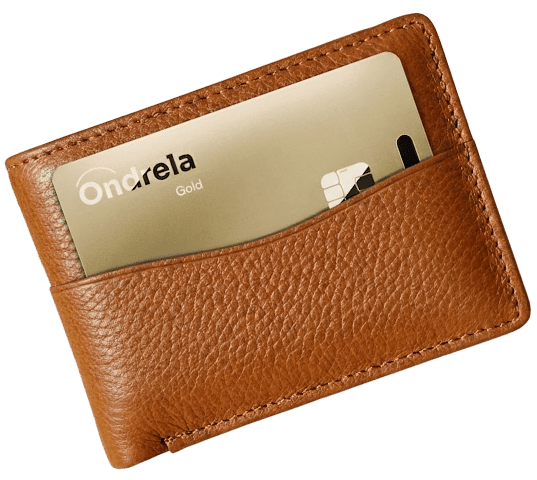
Made for the card slot: at 1.7 mm, the Ondrela card sits between your bank cards instead of bulging out of the wallet (vendor image).
Ondrela is a brand of UAB Domestica, a direct-to-consumer company based in Kaunas, Lithuania. The product – officially the Ondrela Gold tracker card, also found as “Ondrela smart card” or “Ondrela tracking card” – is a Bluetooth tracker with the shape and size of a credit card: 1.7 mm thin (about 1/16 inch), gold-colored, with a built-in speaker, a rechargeable battery, a coil for wireless charging and a radio chip that registers with Apple’s Find My network or Google’s Find Hub network (which Android users may still know as Find My Device). Put the card in your wallet and your phone shows where the wallet is on a map. Walk away from it and your phone tells you. Lose it under the sofa cushions and you make it ring.
Why a card? The best-known tracker on the market is a round coin about 8 mm thick. It is excellent on a key ring or in a bag, but it doesn’t fit into a card slot and leaves a lump in a slim wallet; keyring tags have the same problem. For wallets, passport holders and card cases, the credit-card format has therefore become its own category – “wallet tracker card”, “tracking wallet card” and “card tracker for wallet” are among the most-searched terms in the whole tracker market. The Ondrela card disappears between your bank cards, and you forget it’s there until you need it.
Ondrela adds three things that set it apart. First, the look: the card is designed to resemble a premium gold bank card. The vendor’s headline – “Everyone Sees a Gold Card. It’s a Tracker.” – comes with the argument that the card is “too valuable for a thief to discard, yet too discreet to suspect”. Second, it recharges wirelessly; many tracker cards have a sealed battery, and when it is empty after a couple of years the whole card is done. Third, you choose your platform: the same card works with the Apple network or the Google network – the two largest finding networks in the world, because they consist of the phones people carry anyway.
Phrases such as “Built on the Japanese philosophy of precision”, “4.4/5 – trusted by 19,314+ customers” and discounts of up to 70% are vendor statements; what interested us was whether the card makes lost things findable in everyday life. The full product description and current pack prices are on the official Ondrela website.
Lost wallet, missing suitcase: what a tracker card can and can’t do
Every Bluetooth tracker card works the same way, whatever the brand: no GPS receiver, no SIM card, just a small encrypted Bluetooth signal every few seconds, with a range of a few dozen meters in open space and less through walls and bags. If your own phone is within range, the app shows the card as “nearby” and can make it ring. If not, the network takes over: every iPhone (for Find My) or Android phone (for Find Hub) that passes the card picks up its signal and reports the location to the cloud – anonymously and end-to-end encrypted. You see a dot on your map with a time stamp; the stranger whose phone relayed it notices nothing. In a city center, on the subway or in an airport this happens practically all the time. On a quiet country road, the last known location stays on the map until the next phone comes by.
- Misplaced at home or in the office: The core discipline. Tap “Play Sound”, follow the beep, done in seconds.
- Left behind in a café, taxi or hotel lobby: The left-behind alert reports as soon as your phone moves away from the card, with the place where the connection dropped. After that, passing phones keep the position up to date.
- Luggage on a trip: This is where crowd-network trackers shine, because airports and stations are full of phones. You see whether your suitcase is at the departure airport, at the destination or already on the belt – without roaming, SIM or subscription.
- Theft: The location helps you inform the police – don’t go after a thief yourself. Modern phones notify their owners when an unknown tracker travels with them for a while (an anti-stalking safeguard), so a thief can be alerted to the card. The bank-card look is the vendor’s answer to that – a good argument, not a guarantee.
- Live tracking of people, pets or cars: Not what Bluetooth tracker cards are made for. That needs a GPS tracker with its own SIM card and usually a monthly fee – and tracking another person without their consent is illegal in most countries.
In short: for wallets, keys, backpacks and luggage, a crowd-network tracker card without running costs is exactly the right tool – as long as you think of it as a finder rather than a GPS beacon.
Ondrela smart tracker technology: Find My, Find Hub, ring and battery
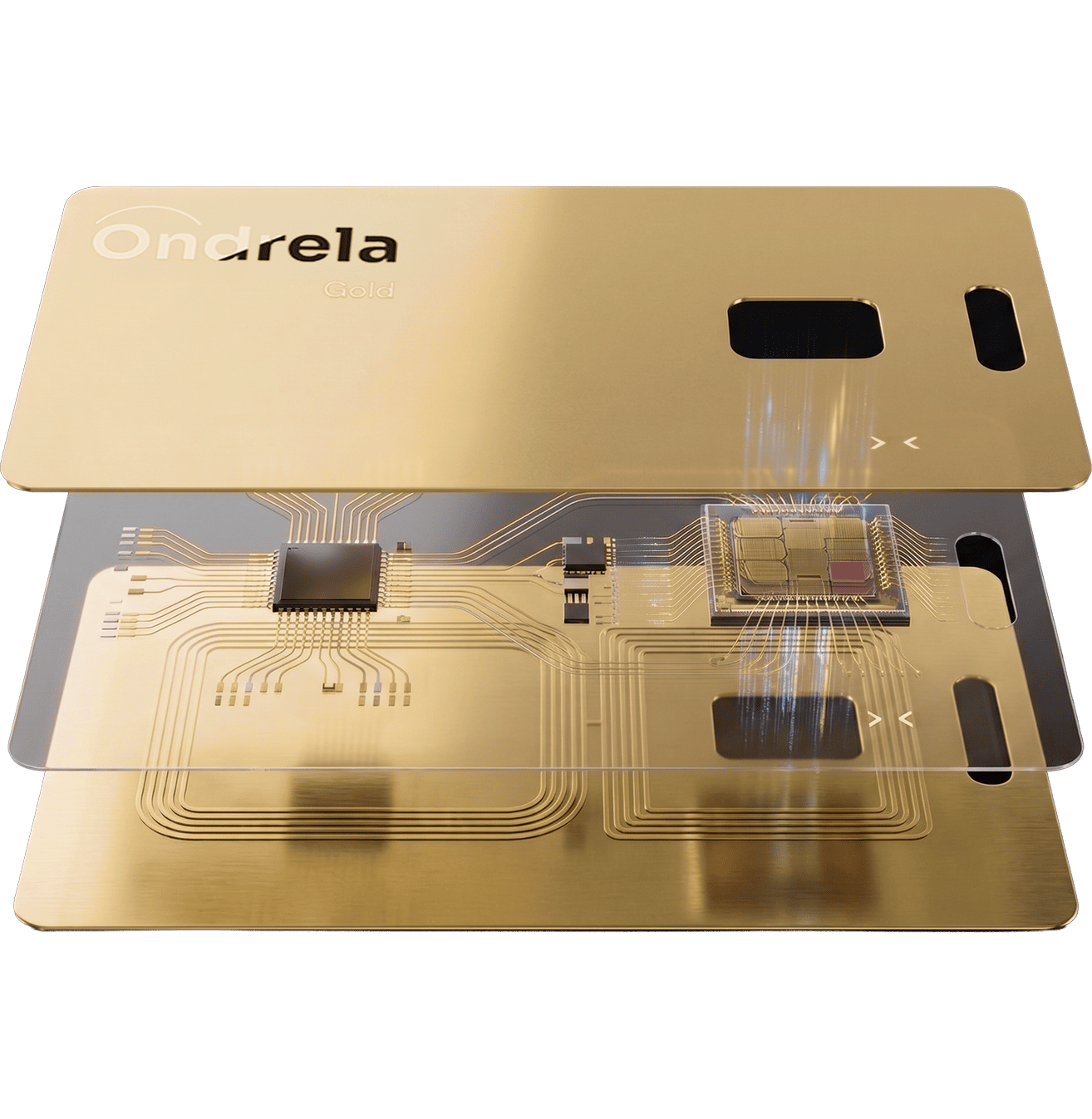
Layer by layer: the vendor’s illustration of what sits inside the 1.7 mm card – chips, antenna and charging coil between two gold-colored covers.
The vendor keeps the technology simple: a thin card, a chip that talks to your phone’s own tracking network, a speaker, a battery you charge wirelessly. Here are the vendor’s statements next to our assessment from four weeks of use:
| Feature | What the vendor says | Our assessment |
|---|---|---|
| Format | Credit-card size, 1.7 mm thin; “slides smoothly into any standard wallet slot” | A bank card is 0.76 mm thick, so the Ondrela card is roughly two bank cards stacked. It fit every regular card slot we tried; in a tight minimalist wallet with six cards it was snug. |
| Network | Works with Apple Find My (iPhone) and Google Find Hub (Android); no extra app, no account | The biggest plus: instead of a small brand-owned community, the card uses the phones of hundreds of millions of people as its search network. One card is paired with either Apple or Google, not both at once – as with all trackers in these networks. |
| Ring | Built-in alarm – “Can’t find it? Make the card ring.” | Clearly audible at home, even from a closed wallet; quieter in noisy surroundings, as with every flat card with a small speaker. No decibel figure is given. |
| Left-behind alert | “Get alerted when you leave it behind”, with the last known location | On the iPhone this is the Find My option “Notify When Left Behind”, with exceptions for trusted places; in our test it fired after a few minutes’ walk. On Android, Find Hub handles the alerts, and the options depend on phone and Android version. |
| Battery | About 6 months per charge; wireless charging on any standard pad, “a few hours twice a year” | Rechargeable is still the exception among tracker cards and a real advantage over a sealed battery. After four weeks none of our cards had reported a low battery; the full six months we can’t confirm yet. |
| Water | “100% water resistant” | Rain and a spilled drink: no problem in our test. No IP rating is stated, so no swimming, no washing machine. |
| Not stated | – | Bluetooth version, range in meters, volume in decibels, battery capacity, IP rating, ultra-wideband (UWB) for arrow-guided finding. Our iPhone offered sound-based finding, no arrow. |
Our assessment: the Ondrela card offers what a good tracker card should in 2026 – plus wireless charging and the choice between the Apple and Google networks. A data sheet would be welcome; the features that matter in everyday use all work as described.
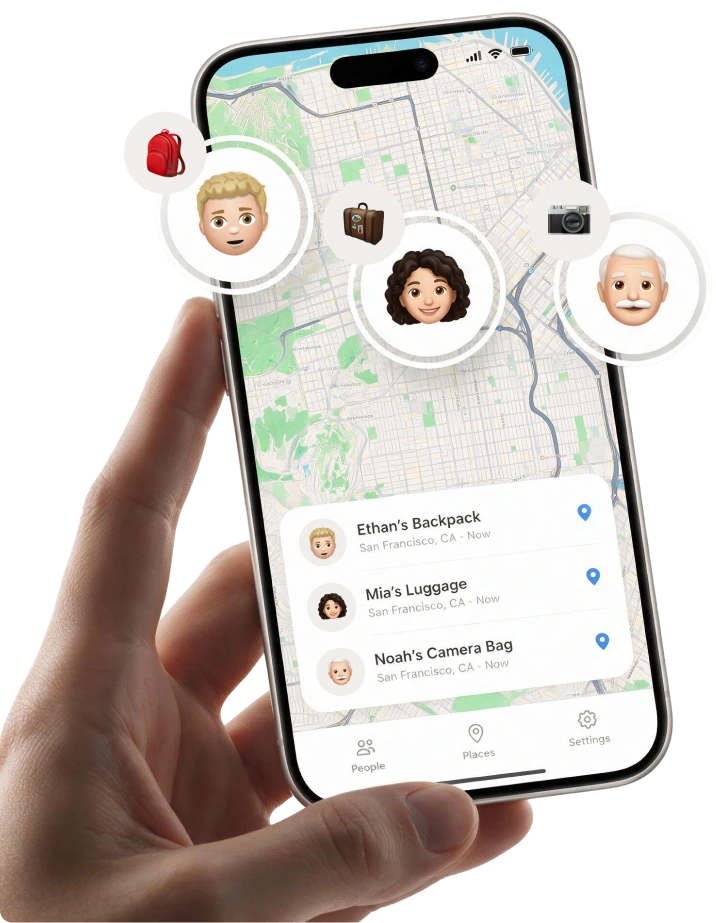
One map for everything: the Ondrela card appears in the phone’s own tracking app next to your other devices – and, if they share it, your family’s locations (vendor image).
Because everything runs through the phone’s own app, the card inherits its extras: in Find My you can mark it as lost with a contact message for finders (Find Hub has its own options, depending on the Android version), and the same map shows the locations family members choose to share with you – the “peace of mind” the vendor talks about.
The location reports that strangers’ phones relay are end-to-end encrypted: according to Apple and Google, only you as the owner can see where your card is. In the other direction, iPhones and Android phones warn their users when an unknown tracker has been moving with them for a while, and trackers in these networks beep by themselves after a long time away from their owner. That protects everyone from misuse – and it is why a tracker card is a finder for your belongings, not a covert anti-theft device.
Ondrela review: how we tested
A tracker card has to fit into your wallet, set up without frustration, show you where your things are, ring loud enough to be found and keep going for months. For this Ondrela review we ordered four cards through the official shop like any customer and rated six criteria:
- Build & format: Thickness, stiffness, edges, fit in a bifold wallet, a card holder, a passport holder and a key-ring sleeve.
- Setup & compatibility: Pairing with the iPhone (Find My) and with Android (Find Hub), time needed, switching between the systems.
- Locating & reliability: At home, downtown, on public transport, at the airport and in the countryside; update frequency; left-behind alerts.
- Ring & finding nearby: Volume in a wallet, a bag and under clothing.
- Battery, charging & water: Battery after four weeks, charging on standard wireless pads, rain and spills.
- Vendor & value: Product information, company details, shipping, returns, price per card in the real checkout.
Test setup: three testers, four cards, four weeks. Card one lived in a leather bifold wallet paired with an iPhone 15 – subway commute, office, cafés. Card two went into a slim card sleeve on a key ring, paired with a Google Pixel 8. Card three rode in the saddle bag of a commuter bike paired with a Samsung Galaxy S24 – parked at a busy train station on weekdays, taken on countryside rides at the weekend. Card four traveled in a suitcase on a train trip and a return flight with a layover, paired with an iPhone 13.
The Ondrela card in practice: wallet, keys, luggage and bike
Unboxing and first impression
Each card comes in a small box with a quick-start guide that boils setup down to the vendor’s three steps: unbox, connect it in your phone’s tracking app, slip it into your wallet or bag. The card is stiff, with neatly rounded corners and a gold finish with the Ondrela lettering – at arm’s length it passes for a premium bank card, and nobody at the office guessed it was a tracker. It is noticeably thicker than a bank card but far slimmer than any coin-shaped tracker. In a bifold wallet it simply disappeared into a slot; in a minimalist card holder with six cards it was tight, so we moved one rarely used card elsewhere. In a passport holder it slid in behind the passport without any bulge.
Setup on iPhone vs. Android
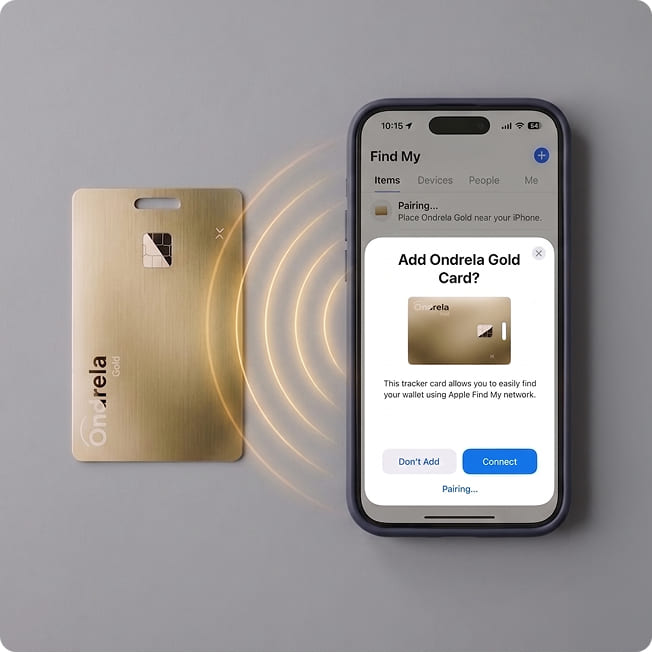
Connect, name, done: pairing runs through the tracking app that is already on your phone (vendor image).
On the iPhone: open Find My, go to “Items”, add an item and choose “Other Supported Item”. After we had activated the card as the quick-start guide describes, the iPhone found it within seconds; we named it “Wallet”, picked an emoji and switched on “Notify When Left Behind” – well under a minute. On Android: on the Pixel and the Galaxy, a pairing pop-up appeared by itself as soon as the card was ready; one tap to confirm, a name, and the card showed up in Find Hub among our devices – under two minutes. No separate app, no new account, no password: the card simply uses the Apple or Google account you already have on the phone, exactly as the vendor promises.
We also switched sides: card three started on an iPhone and later moved to the Galaxy. After removing it from Find My and resetting it as described in the instructions, it paired with Find Hub without problems. Both networks at the same time isn’t possible – so if you carry an iPhone and an Android phone, pair the card with the one that is always with you.
Wallet: café test and left-behind alerts
For the staged test, we left the wallet on a café table and walked off. After about three minutes the iPhone showed a “left behind” notification with the café as the location, and the position kept updating every few minutes through other iPhones passing by until we picked the wallet up. More convincing were the two real slips during our four weeks: once the wallet stayed on a restaurant bench, once in the door pocket of a friend’s car. Both times the alert reached the tester within a few streets. After a week we added home and the office as trusted locations, so the alert stopped firing when the wallet stayed on the hallway dresser on purpose. On the subway and at the office, the card did what a good wallet tracker should: nothing at all, until it was needed.
Keys at home: how loud is the ring?
Card two, in a slim sleeve on a key ring, was mostly about finding things nearby. In a quiet apartment, “Play Sound” produced a clear, high beep that we could hear from the next room with the door open. Under two sofa cushions it was muffled, and we had to be in the same room; with the TV on or the vacuum running, you need to be close. In a busy café you will barely hear it beyond arm’s length – in public you use the map, at home you use the sound. That is the physics of a speaker inside a 1.7 mm card; tag-shaped trackers with a bigger speaker are louder. Our tip: use the outermost card slot – the less leather around it, the better you hear it.
Luggage: train trip and a flight with a layover
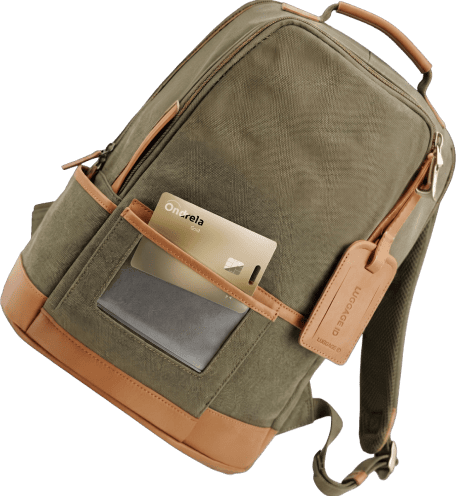
Into the inner pocket and forget it: in a backpack or suitcase the card stays invisible (vendor image).
Card four went into the zipped inner pocket of a suitcase. On the train, the dot moved along the route, with updates especially around stations. The flight was the real test. At the destination, the suitcase appeared at the airport on the map before the baggage belt had even started. On the way back, with a tight connection, the app still showed the suitcase at the connecting airport while we were already seated on the second flight. It arrived on the next plane a few hours later, and we knew where it was before the baggage desk did, which made the report much quicker. On recent iOS versions, Find My can also share an item’s location with an airline via a link, where the airline supports it – an Apple feature for Find My accessories, not a promise Ondrela makes itself.
Bike: busy train station vs. countryside trailhead
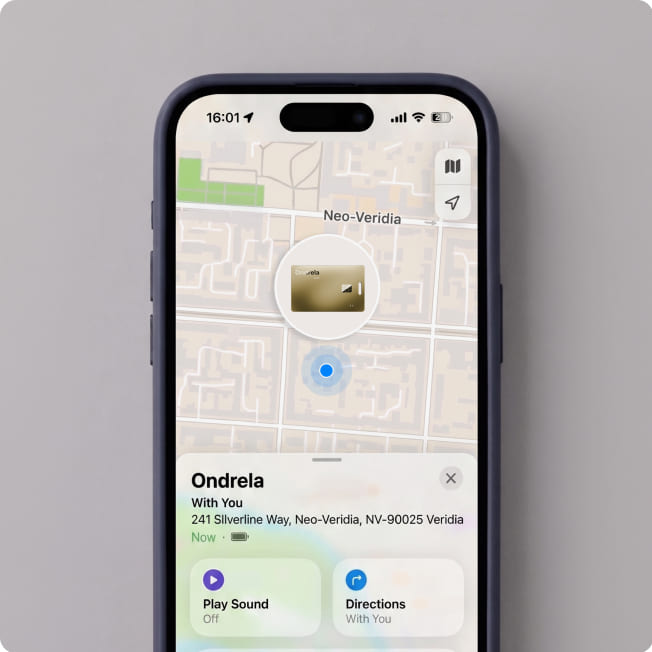
Where is it right now? The card’s position appears on the map of your phone’s tracking app, with a time stamp of the last update (vendor image).
Card three, in the saddle bag of a commuter bike paired with the Galaxy S24, showed the difference between city and countryside most clearly. On weekdays the bike stood at a busy train station from morning to evening; Find Hub showed a fresh position whenever we checked, usually just minutes old. At the weekend we left the bike at a countryside trailhead and went hiking for three hours. The map showed the trailhead from the moment we walked away, and the next update only came about two hours later, when another group arrived at the parking area. That isn’t a fault – it is how every crowd-network tracker works: no phones around, no new position, and the next passer-by refreshes it. On Android it is worth checking the Find Hub network setting: allowing it to work in all areas, not only in high-traffic areas, gives it more chances in quiet places. Minute-by-minute tracking of a moving bike on empty roads is a job for a GPS tracker; for a bike parked in town, the Ondrela card did the job well.
Battery, wireless charging and water
After four weeks, none of the four cards had reported a low battery, and all of them still rang as loudly as on day one; the six months we couldn’t verify in that time, but nothing pointed the other way. To try the charging routine, we put one card on two ordinary wireless charging pads of the kind you use for your phone. Lay it flat, the pad’s charging light comes on, leave it for a few hours as the vendor recommends. On one pad we had to shift the card slightly until the coils lined up; on the other it started straight away. The wallet with card one got caught in a heavy rain shower, and card two survived a knocked-over glass of water – both without any effect.
The Ondrela card does exactly what a tracker card should, with the Apple or Google network behind it. Twice the left-behind alert rescued a forgotten wallet, once the card took the stress out of a delayed suitcase, and the bike at the train station was on the map whenever we looked. Setup was quicker than unboxing, the card disappears in the wallet, and instead of ending up in the trash after a couple of years it goes onto a charging pad twice a year. The limits are those of every Bluetooth tracker: no GPS, no arrow, a ring made for quiet rooms, and fewer updates where few people pass. If that is what you expect, the Ondrela tracker card is one of the most convenient ways to keep your wallet, keys and luggage findable.
What the Ondrela tracker can’t do – an honest list
A good score needs clear limits. Here is what the Ondrela card is not, and what you should know before you order:
- It is a Bluetooth finder, not a GPS tracker. The card is “seen” by passing phones of its platform. In cities, on public transport and at airports that works superbly; on a forest trail or in a remote parking lot, the map shows the last known location until the next phone comes by. Live tracking of a moving car isn’t what it is built for.
- One network at a time. Apple Find My or Google Find Hub – not both simultaneously. If you switch from iPhone to Android (or back), you reset the card and pair it again.
- No arrow to the card. Ultra-wideband “precision finding” isn’t part of the feature list. Nearby, you find the card by sound.
- The ring is made for quiet rooms. Easy to hear at home, quieter in a noisy café or under a thick coat – true of all flat cards with a small speaker.
- A finder, not an anti-theft device. Phones warn people about unknown trackers traveling with them, so a thief may notice the card after a while. The bank-card look is the vendor’s argument for why a thief would keep it – plausible, not guaranteed.
- Technical data is sparse. Bluetooth version, range, decibels, battery capacity and an IP rating are not stated; “100% water resistant” isn’t a standardized rating.
- You need a compatible phone. An iPhone with Find My or an Android phone with Google services and Find Hub.
- Vendor figures are vendor figures. “4.4/5”, “Trusted by 19,314+ customers”, the discount percentages and the testimonials come from the vendor’s page, which states that it usually does not post negative reviews.
- Price and delivery. A single card at €44.99 costs more than many tracker cards; in the packs it drops to €24.99. Delivery from the EU takes 8–18 business days depending on the country, with possible import charges outside the EU.
None of this speaks against the product – these are the limits of the Bluetooth tracker category plus the specifics of a direct-to-consumer brand. Within those limits, the Ondrela card convinced us.
Our rating in detail
What speaks for Ondrela
|
What you should know
|
The deductions are for the ring volume in noisy places, the missing arrow-guided finding, the sparse technical data and the price of a single card – not for format, setup or locating, where the card was excellent. Company details, a contact form, a customer-service line, order tracking, written shipping and return policies and an EU Declaration of Conformity are all in place. Among tracker cards for the wallet, Ondrela is one of the most convenient we have tested – mainly thanks to the choice of network and wireless charging.
Ondrela vs. AirTag, other wallet tracker cards and GPS trackers
“AirTag card”, “best wallet tracker card”, “wallet tracker Android”, “GPS wallet tracker” – people compare very different things. This is how the Ondrela card fits in, by category, based on our test and general product knowledge:
| Option | Fits a card slot? | Phones & network | Battery | Our take |
|---|---|---|---|---|
| Ondrela tracker card | Yes, 1.7 mm | iPhone (Find My) or Android (Find Hub), one at a time | Rechargeable wirelessly, approx. 6 months (vendor) | Our pick for the wallet: card format, choice of network, no throwaway battery, discreet look. No arrow-guided finding; online only. |
| Coin-shaped tracker (e.g. Apple AirTag) | No, about 8 mm thick | iPhone only (Find My) | Replaceable coin cell | Excellent for keys and bags, with Precision Finding on compatible iPhones. Too thick for a card slot; not for Android. |
| Tracker cards with a sealed battery | Yes | Find My or Find Hub version, depending on model | Non-rechargeable, usually a couple of years | Same principle and networks; when the battery is empty, the card is replaced as a whole. |
| Tracker cards with a brand-owned app | Yes | iPhone and Android via the brand’s app | Varies | One app for both platforms, but a much smaller network than Apple’s or Google’s; some extras sold as a subscription. |
| Keyring tags for one phone brand (e.g. Samsung) | No | Only that brand’s phones | Replaceable coin cell | Strong within their ecosystem, partly with ultra-wideband; tag format, not for wallets. |
| Budget no-name tracker cards | Yes | Usually Find My only | Mostly sealed | Low price; build, ring volume and support vary a lot. |
| GPS tracker with SIM card | No | Own app, any phone | Days to weeks | Live tracking wherever there is cellular coverage – for cars, pets, remote areas. Monthly fee, too bulky for a wallet. |
Our conclusion: for keys on an iPhone, a coin-shaped tracker with arrow-guided finding is a great choice – it just doesn’t fit into your wallet. For the wallet, passport holder and card case, the card format is a must, and here the Ondrela card offers the best combination we have seen of network choice, wireless charging and a look that doesn’t give it away. For live tracking of vehicles or pets, a GPS tracker with SIM remains the right category.
Setup step by step: iPhone and Android
iPhone (Apple Find My)
- Check the basics: up-to-date iOS, Bluetooth on, Find My enabled, Location Services allowed.
- Activate the card as described in the quick-start guide in the box.
- Add it: Find My → “Items” → add an item → “Other Supported Item”; choose a name and an emoji (for example “Wallet”) and confirm.
- Switch on the alert: tap the item → “Notify When Left Behind” → add trusted places such as home as exceptions.
- Test it: tap “Play Sound”, then slip the card into the outermost slot of your wallet.
Android (Google Find Hub)
- Check the basics: Google services, Bluetooth and location on, the Find Hub app (pre-installed on many phones, otherwise from the Play Store) and the finding network activated.
- Activate the card as the quick-start guide describes – most phones then show a pairing pop-up by themselves.
- Connect: confirm the pop-up and name the card; it appears in Find Hub among your devices.
- Set up notifications: open the card in Find Hub and switch on the alerts your phone offers – options depend on Android version and phone model.
- Test it: tap “Play Sound”. For quiet areas, allow the network to work in all areas, not only high-traffic areas.
Outer slot: the less leather around the card, the louder the ring. Charging reminder: a calendar entry every five months keeps cards from going on a trip half empty. Clear names: “Wallet”, “Passport”, “Blue suitcase”, “Bike” save time once you have three or four cards. Before giving a card away: remove it from your app first, so the next owner can pair it.
Who the Ondrela card is for – and who should skip it
Peace of mind for the whole household: tracked items and – where family members share it – their location on one map (vendor image).
The Ondrela tracker card makes sense for you if:
- You regularly search for your wallet or leave it somewhere – at home, in cafés, restaurants, taxis or the car.
- You travel a lot and want to keep an eye on your suitcase, passport holder and carry-on without roaming, SIM or subscription.
- You use Android and want an “AirTag alternative for Android” in card format – or you use an iPhone and find a coin tracker too bulky for your wallet.
- You want to give an older family member’s wallet a finder: the family sets it up once, then it runs by itself.
- You commute by bike and want to know where it is parked – especially in towns and at stations.
- You are looking for a useful gift – according to the vendor, most customers end up ordering three or four cards: wallet, bag or passport holder, luggage and one to give away.
You can skip it if:
- You want live, minute-by-minute tracking of a car, a pet or valuables in remote areas – that is a job for a GPS tracker with SIM.
- Your phone has neither Find My (iPhone) nor Google services (Android).
- You only want to track keys with an iPhone and value arrow-guided finding above everything.
Trackers may only be used for your own belongings or with the clear consent of the people concerned; hiding a tracker in someone else’s bag or car is a criminal offense in many countries. If something is stolen, share the location with the police instead of going there yourself.
Ondrela reviews and complaints: what buyers report
“Ondrela reviews and complaints”, “Ondrela review Reddit”, “Ondrela gold card reviews” – people want to know what other buyers say. The vendor’s page shows “4.4/5”, the line “Trusted by 19,314+ customers” and dated testimonials from 2026, and states openly: “We usually do not post negative reviews.” These are vendor-published reviews whose figures we can’t verify. What we can do is compare the stories with our own four weeks and with the feedback patterns typical for tracker cards:
| What customers say (vendor page) | Does it match our test? |
|---|---|
| Margaret R.: her wallet was stolen on the subway; she watched it move on the map, called the police and had it back within two hours. | Plausible: the subway is where the network is densest, and in busy places our positions updated every few minutes. Leaving the recovery to the police, as she did, is exactly right. |
| Barbara K.: her husband used to lose his wallet every week; now he finds it in seconds. | Yes – finding things at home is the card’s core discipline. |
| David T.: left his passport holder in a taxi; his phone beeped in the hotel lobby. | Matches our left-behind tests: on the iPhone the alert came within a few minutes. |
| Typical praise for tracker cards: “finally fits into my wallet”, “set up in two minutes”, “no extra app”, “rechargeable”. | All confirmed in our test. |
| Typical criticism of tracker cards: “the ring could be louder”, “rare updates in the countryside”, “delivery took a while”, “no technical specs”. | These apply to Ondrela as well – see our list of limits. |
The pattern is consistent: buyers praise the format, the easy setup and the strength of the Apple and Google networks, and mention ring volume in noisy places, sparse updates in remote areas and delivery time as drawbacks. On Amazon you won’t find reviews of the original Ondrela card, because it isn’t sold there. We are not aware of any test by Consumer Reports, Which? or a comparable organization – this Ondrela review is based on our own practical test and the vendor’s published information.
Is Ondrela legit? Company, support and returns
“Is Ondrela legit?” and “Ondrela scam” come up for almost every brand that sells only online, so we looked at the company behind it. The official shop is operated by UAB Domestica, a limited company registered in Lithuania (Gedimino g. 45-7, LT-44239 Kaunas; company number 307174704; VAT ID LT100018934013). The same EU company runs other established direct-to-consumer brands, including the Fuugu cleaning products we have reviewed separately. The shop publishes terms of service, shipping and return policies, a contact form, an order tracking page and a customer service number (+1 970 236 2765), and the site links to an EU Declaration of Conformity.
The 60-day return policy is clearly written: within 14 days of delivery you get the full price including the original delivery fee back; from day 15 to day 60 the product price. You request a return authorization (RMA) from support first – replies within three business days – and the refund follows within 14 days after the return arrives. Payment runs through an express checkout, credit or debit card or Klarna. Our order arrived complete, and all four cards worked exactly as the product page explains. In short: a real product from a registered EU company with written policies and reachable support – legit, not a scam.
Where to buy Ondrela: Amazon, Best Buy or the official shop?
“Buy Ondrela”, “Ondrela card where to buy”, “Ondrela tracker Amazon” – the answer in October 2026 is simple: the Ondrela tracker card is sold directly by the manufacturer through its official online shop. It isn’t available on Amazon or eBay, at Best Buy, Currys, Argos or other electronics chains. That is the direct-to-consumer model, and it works in your favor: no retail markup, the pack prices straight from the brand, quality control and support from the company that ships the card, and the 60-day return policy on your order. The shop delivers to the US, the UK, Canada, Australia, Ireland and most of Europe, and its checkout automatically shows prices in your local currency. If you want the card we tested, order it there.
Ondrela price: packs, shipping and the 60-day return policy
We went through the order process ourselves, from the product page via the discount button to the order page. These are the four packs we saw in October 2026 for a delivery address in Germany, in euros – all one-time purchases with no subscription and no monthly fees. Reference prices and discounts are vendor figures; what counts is the price per card:
| Pack | Price | Per card | Reference price & discount (vendor) | Good for |
|---|---|---|---|---|
| 1 card | €44.99 | €44.99 | €82.99, −46% | Just your wallet |
| 2 cards | €69.98 | €34.99 | €165.98, −58% | Wallet and passport holder – or one for your partner |
| 3 cards | €89.97 | €29.99 | €248.97, −64% | Wallet, backpack and suitcase |
| 4 cards (“Most popular”) | €99.96 | €24.99 | €331.96, −70% | Families, frequent travelers, gifts |
Plus €4.95 standard shipping to our German address. Compared with buying single cards, the 2-pack saves €20, the 3-pack €45 and the 4-pack €80. A single card is on the expensive side; from three cards (€29.99) or four (€24.99) Ondrela is one of the most affordable rechargeable tracker cards with a choice of network – and since the networks are free and the battery is recharged, there are no running costs afterwards. Our recommendation: the 3-pack or 4-pack. A card in the suitcase and one in the passport holder pay off on your first trip.
- Currency: the shop shows prices in the currency of your location – from the US, UK, Canada or Australia you see dollars or pounds before you pay; we don’t list converted prices because the shop calculates them itself.
- Shipping: processing 1–2 business days; delivery 8–12 business days to the US and UK, 10–14 to Australia, 12–18 to Canada, 12–15 to Ireland, with tracking. Outside the EU, import duties or fees may apply.
- Returns: 60 days – full refund including original delivery within 14 days, product price from day 15 to 60; RMA via support first, original packaging, return postage at your cost.
- Support: contact form and order tracking on the official website, customer service +1 970 236 2765.
Ondrela FAQ: frequently asked questions
Does Ondrela work?
In our four-week test, yes: setup in under two minutes, two forgotten wallets rescued by the left-behind alert, a delayed suitcase located at the connecting airport, a bike at a busy station on the map whenever we checked. In the countryside, updates come less often – true of every Bluetooth tracker.
Is there an Ondrela app – and do I need a subscription?
No and no. The card uses the app already on your phone – Find My on the iPhone, Find Hub on Android. No separate app, no new account, no monthly fee.
Does Ondrela work with Android and iPhone?
Yes, with both, but one at a time: iPhone via Apple Find My, Android via Google Find Hub (formerly Find My Device), which requires Google services. To switch, remove the card from one app, reset it and pair it with the other.
Does the Ondrela card have GPS?
No. Like all tracker cards, it works with Bluetooth and the network of nearby phones, which is why it needs no SIM and runs for months on one charge. In cities and at airports this is very reliable; in remote areas the last known location stays on the map until a phone passes. Live tracking anywhere needs a GPS tracker with SIM.
How long does the Ondrela battery last, and how do I charge it?
According to the vendor, about six months per charge. Lay the card flat on any standard wireless charging pad for a few hours, twice a year. After four weeks none of our cards reported a low battery, and charging worked on two ordinary phone pads.
How loud is the ring?
Easy to hear in a quiet home – in our test from the next room – even from a closed wallet. In noisy places or under thick clothing it is quieter. No decibel figure is given; keep the card in the outermost slot.
Is the Ondrela card waterproof?
The vendor calls it “100% water resistant”, and rain and spills were no problem in our test. No IP rating is stated, so don’t submerge it.
Ondrela card vs. AirTag: is there precision finding (UWB)?
Ultra-wideband isn’t in the feature list; nearby, you find the card by sound. Its advantages over a coin-shaped tracker are the 1.7 mm format that fits a card slot and compatibility with Android as well as the iPhone.
What does “tracker detected near you” mean – will a thief be warned?
Phones warn their users when an unknown tracker travels with them for a while – an anti-stalking safeguard for all trackers in the Apple and Google networks. A thief with a phone may therefore notice the card. The vendor argues the bank-card look makes it less likely to be thrown away. If something is stolen, give the location to the police.
Can I put the Ondrela card in checked luggage?
Small trackers with tiny built-in batteries are commonly carried in checked bags, and our card traveled in a checked suitcase without any issue. Rules are set by airlines and aviation authorities, so check your airline’s guidance if unsure.
What does Ondrela cost?
In the official shop (October 2026, euros for a German address): 1 card €44.99, 2 cards €69.98, 3 cards €89.97, 4 cards €99.96 (€24.99 each), plus €4.95 shipping. One-time purchase; the checkout shows your local currency.
Where to buy Ondrela – is it on Amazon?
Ondrela is sold through the official shop only – not on Amazon, not at Best Buy, Currys, Argos or other retailers. There you get the pack prices, tracked shipping, support and the 60-day return policy.
Is Ondrela legit or a scam?
Legit. The shop is run by UAB Domestica, a registered company in Kaunas, Lithuania, with company number, VAT ID, written policies, customer service and an EU Declaration of Conformity. Our cards arrived and worked as described.
How does the 60-day return policy work?
Request an RMA via the contact form (reply within three business days) and send the items back in their original packaging. Within 14 days of delivery you get the full price including original delivery back, from day 15 to 60 the product price; return postage is at your cost.
Ondrela review: our verdict
The Ondrela tracker card solves the problem coin-shaped trackers can’t: it fits into the card slot. There it quietly does its job, plugged into the largest finding networks in the world – Apple Find My or Google Find Hub – without an extra app, account or subscription. In our four-week test, setup took under two minutes, location updates were reliable in cafés, on public transport and at the airport, the left-behind alert rescued a forgotten wallet twice, and a delayed suitcase showed up on the map before the airline knew where it was. Instead of ending up in the trash after a couple of years, the card goes onto a charging pad twice a year. In the packs it costs from €24.99 per card, from a registered EU company with a 60-day return policy. Score 8.4/10 – very good.
Being honest: Ondrela is a Bluetooth finder, not a GPS beacon – where no phones pass, the dot waits for the next one. There is no arrow-guided finding, the ring is made for quiet rooms, and the card works with one network at a time. If you want a finder for your wallet, passport holder, backpack, suitcase and bike that you set up once and then forget, the Ondrela card is one of the best tracker cards we have tested – and in the 3-pack or 4-pack one of the most affordable with network choice and a rechargeable battery.
More information on compatibility, setup, shipping and returns is available on the official Ondrela website.
Transparency notice: This article contains affiliate links. If you order through one of these links, we receive a commission – the price for you does not change, and our rating is not influenced by it. Information on battery life, water resistance, compatibility, customer numbers and reviews comes from the vendor. Apple, Find My, AirTag, iPhone, Google, Find Hub, Android, Pixel and Samsung Galaxy are trademarks of their respective owners and are mentioned only to describe compatibility and for comparison. Trackers may only be used for your own belongings or with the consent of the people concerned. Prices and discounts as shown in the vendor’s shop in October 2026 for a delivery address in Germany, displayed in euros; the shop shows prices in your local currency; subject to change.

- Ondrela Review 2026: Is the Ondrela Tracker Card Legit? Real-World Test, Pros & Cons - 27. October 2026
- Wellaray Coffee Booster Reviews 2026: Does the Slim Coffee Booster Work? Ingredients, Side Effects & Price - 27. October 2026
- Matsato Knife Review 2026: Is the Osuren Chef Knife With the Finger Hole Worth It? - 27. October 2026


