
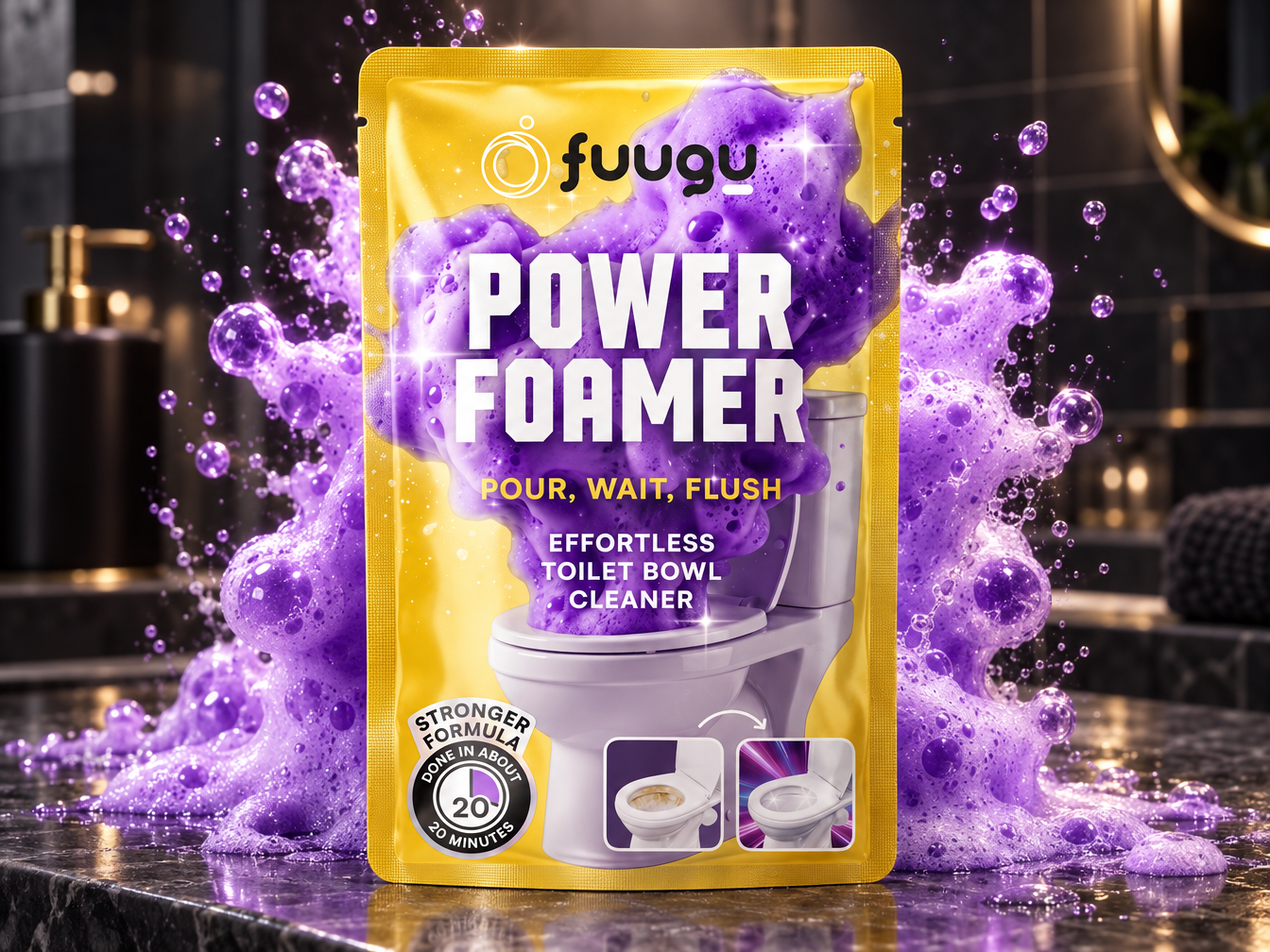
Fuugu Toilet Bowl Cleaner Review 2026: Does the Purple No-Scrub Foam Really Dissolve Limescale Rings? Test, Ingredients, Price & Honest Verdict
Everyone knows the ring. You scrub it on Saturday, it looks better on Sunday, and by Wednesday the grey-brown line at the waterline is back – because what you were fighting was never dirt but mineral scale bonded to the porcelain. Fuugu (searched for as “Fuugu toilet cleaner”, “Fuugu Power Foamer”, “Fuugu foaming toilet bowl cleaner” or simply “purple toilet foam”) promises to end that cycle with a pre-dosed powder pouch: pour it in, watch a purple foam climb the bowl and pack itself under the rim, close the lid for around 20 minutes, flush – no brush, no gloves, no kneeling. We tested Fuugu for four weeks in three very different bathrooms: a hard-water flat with a years-old limescale ring, a family house with two toilets in medium water, and a holiday rental with rust streaks from iron-rich well water. Below you’ll find what the foam actually did, what the formula is made of, the real prices from the official checkout, the shipping and refund terms from the small print – and an honest view of where a no-scrub cleaner reaches its limits.
Review & Experiences · Last updated: October 2026 · Reading time approx. 22 minutes · Prices checked in the official shop
- 🏆 Our verdict: Fuugu Foaming Toilet Bowl Cleaner – 8.3/10, very good. Pre-dosed powder pouches that turn into a dense purple foam, climb the bowl walls and hold under the rim; citric-acid based, 0 % chlorine bleach, ammonia, quats or biocides; septic-safe when used as directed; one pouch per toilet per week; also usable in bathtubs, sinks and kitchen drains; 60-day money-back guarantee.
- Strengths: In our test the foam removed a fresh waterline ring in a single treatment and cleared a years-old hard-water ring after three weekly pouches – without a single stroke of the brush; no bleach fumes, only a faint, neutral smell; visibly cleaner rim jets and a stronger flush in the hard-water flat; genuinely effortless: tear, pour, wait, flush; dissolves fully in cold water; from €6.95 per pouch in the 12-pack.
- To be honest: Fuugu dissolves limescale and rust – it is not a disinfectant and not a replacement for cleaning the seat, lid and outside of the toilet. Old, thick rings need two to three applications, not one. Foam height depends on the bowl shape and water level; in a deep bowl with a high water line it reached about two thirds of the way up. Per clean it costs more than a bottle of supermarket gel. “4.5/5 from 9,754 reviews”, “Cleans 100 %”, “99 % odour source neutralisation”, “As seen in USA Today / The New York Times / Forbes”, the quoted “chemical expert” and the countdown timer are vendor claims we could not verify. The company ships from Lithuania; delivery takes around 10–14 business days to most European countries; after day 14 the original shipping cost is not refunded.
- Price (official checkout, October 2026, shown in euros for a German delivery address): 2 pouches €29.90 (€14.95 each), 4 pouches €51.80 (€12.95 each), 8 pouches €71.60 (€8.95 each), 12 pouches €83.40 (€6.95 each, “Most Popular”) – plus €5.95 standard shipping; the checkout shows prices in your local currency. One-time purchase, no subscription. Only available from the official shop.
Fuugu at a glance: product, fact sheet, verdict
|
🏆 Verdict: very good
Fuugu Foaming Toilet Bowl Cleaner★★★★☆
Score 8.3/10 · very good
Price: from €6.95 per pouch
2× €29.90 · 4× €51.80 · 8× €71.60 · 12× €83.40 plus shipping |
Fact sheet according to the vendor
|
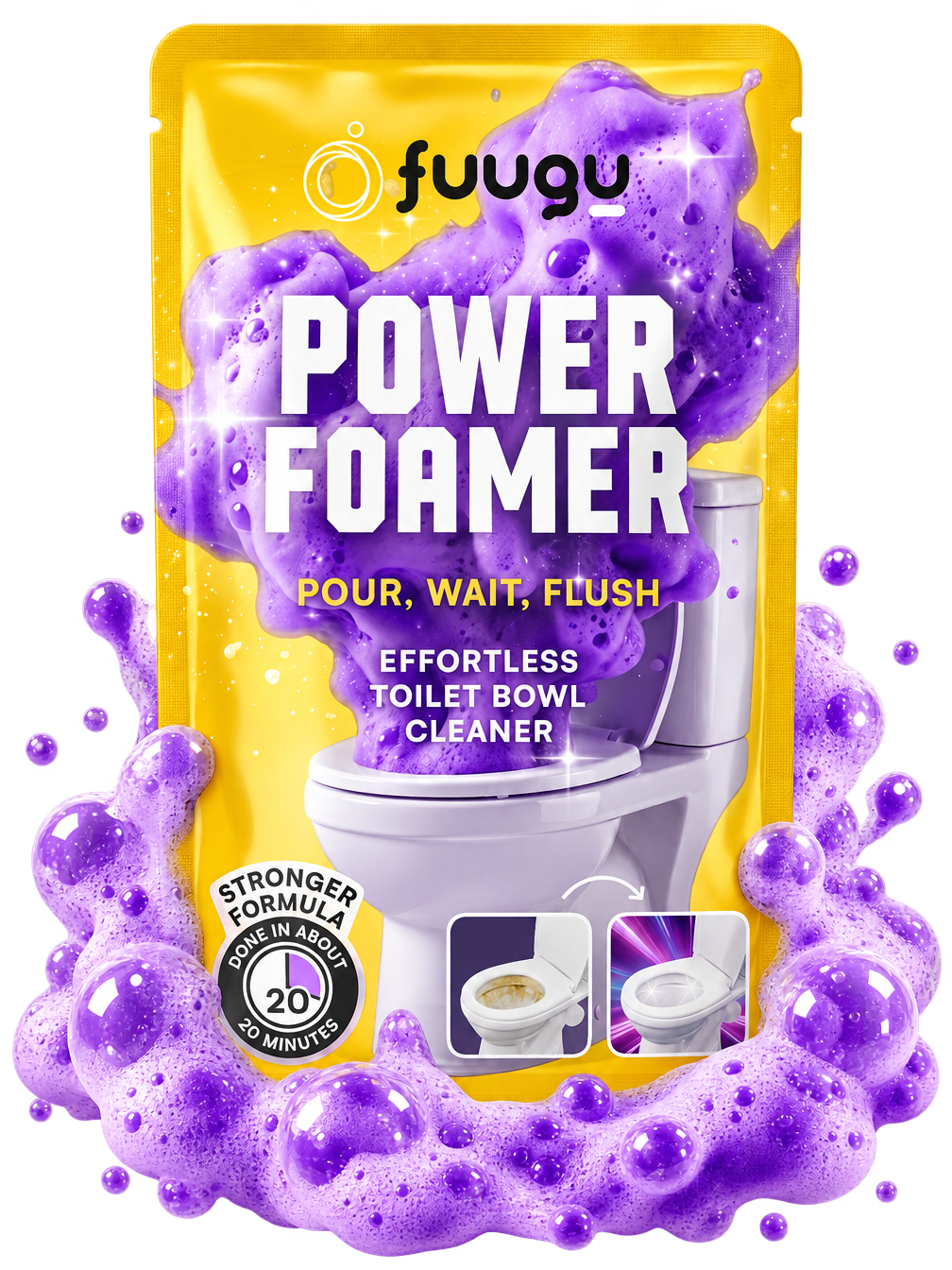
Prices as shown in the official checkout for a delivery address in Germany (euros, excluding shipping), October 2026; the shop displays prices in the currency of your location. Discount percentages are vendor claims.
- What is Fuugu – and how is a foam supposed to replace scrubbing?
- Why the ring keeps coming back – limescale, rust and the bleach trap
- Ingredients and mechanism: citric acid, climbing foam, chelant
- How we tested
- Fuugu in practice: four weeks, three bathrooms, hard and soft water
- What Fuugu can’t do – an honest list
- Our rating in detail
- Fuugu vs. bleach gel, cleaning tablets, vinegar & baking soda, descaler
- How to use Fuugu correctly – step by step
- Who Fuugu is for – and who should skip it
- Fuugu reviews and customer experiences
- Is Fuugu legit? Company, support and guarantee
- Where to buy: Amazon, supermarket or the official shop?
- Prices, packs, shipping and the 60-day guarantee
- Frequently asked questions (FAQ)
- Our verdict
What is Fuugu – and how is a foam supposed to replace scrubbing?
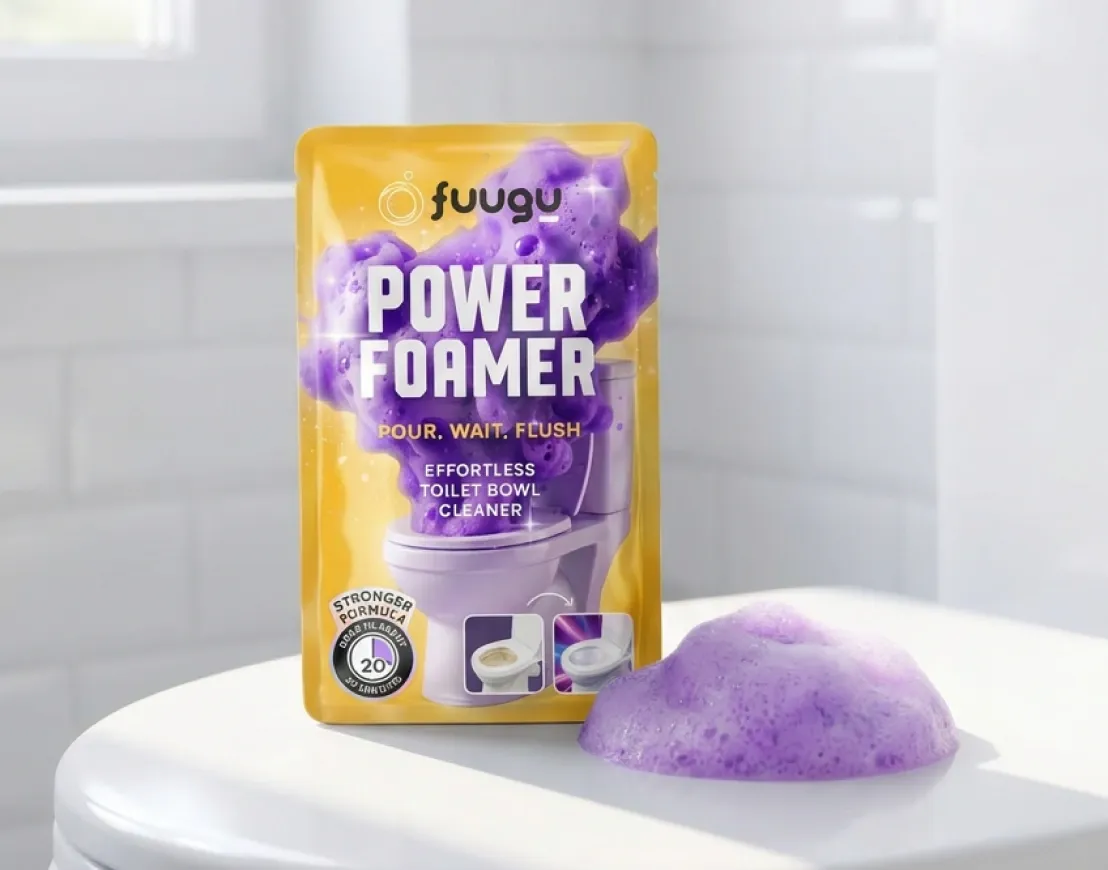
One pouch, one bowl: the powder reacts with the water and builds a purple foam dome that is meant to climb the walls (vendor image).
Fuugu is a foaming toilet bowl cleaner sold as pre-dosed powder pouches by UAB Domestica, a company based in Lithuania, through its own English-language online shop with localised versions for most European countries. The idea is simple: instead of a gel that slides off the porcelain in seconds, or a brush that you push around the bowl, the powder reacts with the water in the bowl and expands into a dense purple foam. According to the vendor, this foam climbs the walls, packs itself under the rim where a brush never reaches, and stays there for roughly 20 minutes while the citric-acid formula dissolves the mineral scale that makes up the familiar grey-brown ring. Then you flush, and the dissolved limescale, rust and grime are supposed to go down with the water. The purple colour isn’t decoration – it shows where the foam is holding and working.
What sets Fuugu apart from the dozens of toilet gels, tabs and “bombs” on supermarket shelves is the combination of three things: the powder format (it arrives dry, so there is no water being shipped and no bottle), the absence of chlorine bleach, ammonia and quaternary ammonium compounds (“quats”) – strength is meant to come from contact time and acid, not from fumes – and the “no-scrub” promise, which the vendor takes seriously enough to call the pouch “the last day you own a toilet brush”. The same pouch can also be used in bathtubs (the grey waterline ring), sinks (limescale spots around the tap and drain) and kitchen drains or garbage disposals (grime and sour smells), with the explicit caveat that it is not suitable for natural stone, marble or unsealed surfaces and that surfaces should be rinsed after use.
The vendor markets Fuugu with “4.5/5 from 9,754 reviews”, “Cleans 100 % of your toilet”, “Dissolves the toughest stains in seconds”, “99 % odour source neutralisation”, an “As seen in” strip naming USA Today, The New York Times, Forbes, Good Housekeeping and others, before-and-after photos of “real dirty bowls”, a quote from a “chemical expert and product tester” and a permanently running “70 % off” countdown. All of that is vendor marketing without a verifiable source, and we treat it as such throughout this review. What interested us was the mechanism – because, unlike a lot of “miracle” cleaning products, the chemistry behind Fuugu is plausible and explained openly on the product page. Whether a foam can really replace a brush in a real bathroom is what we set out to test. (If the brand name sounds familiar: Fuugu also sells dishwasher cleaning tablets, which we reviewed separately.)
Why the ring keeps coming back – limescale, rust and the bleach trap
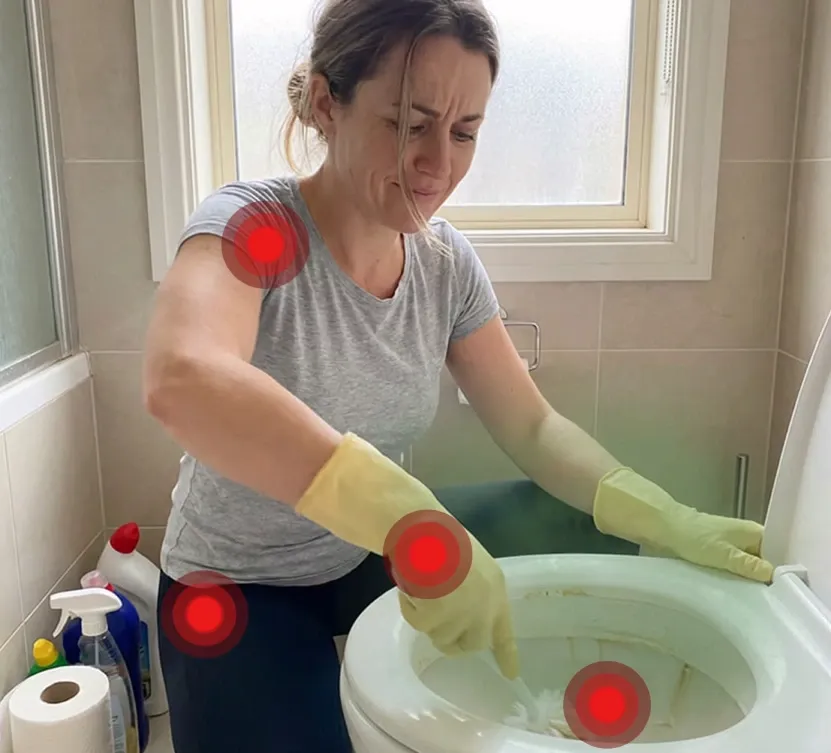
The weekly ritual: knees on the tiles, brush in the bowl – and the ring is back a few days later.
To understand why Fuugu works differently, it helps to know what the ring actually is. Tap water contains dissolved calcium and magnesium – the “hardness”. Every time the water in the bowl evaporates a little at the waterline, or dries on the porcelain under the rim, a thin layer of calcium carbonate is left behind. Layer by layer, that becomes limescale, and limescale is porous: it traps iron from the water (the orange-brown colour), bacteria, organic residue and odours. The ring looks like dirt, but underneath the colour it is a mineral deposit chemically bonded to the glaze of the porcelain. In areas with hard water – large parts of England, Germany, the Netherlands, Spain, Italy, Greece and Hungary, for example – this happens within days.
- Why bleach doesn’t fix it: Chlorine bleach is an oxidiser. It destroys the colour – the iron stains, the organic film – but it does nothing to the calcium carbonate itself. The ring looks lighter for a day or two, then the colour comes back, because the scale was never removed. Bleach also produces fumes, is harsh on septic tanks and shouldn’t be mixed with acidic cleaners.
- Why gels run off: A gel squeezed under the rim slides down the wall in a matter of seconds and ends up diluted in the water at the bottom of the bowl. Its contact time with the ring at the waterline is close to zero – which is why gels mostly perfume the bowl rather than clean it.
- Why scrubbing “works” only briefly: A brush knocks off the loose top layer and the colour. The bonded scale stays, and so does the rough surface that new deposits cling to even faster. Pumice stones do remove scale, but they also scratch the glaze.
- What actually removes scale: Acid. Citric acid, lactic acid, formic acid or diluted hydrochloric acid react with calcium carbonate and turn it into soluble salts that flush away. The catch: the acid needs to stay in contact with the scale long enough – and in a toilet bowl, most of the scale sits above the water, where liquid cleaners can’t stay.
That last point is exactly the problem Fuugu claims to solve: get an acid onto the ring and keep it there for 20 minutes, without you holding it in place with a brush. If the foam really climbs and holds, the chemistry takes care of the rest. If it doesn’t, it is just an expensive purple fizz. That was the question for our test.
Ingredients and mechanism: citric acid, climbing foam, chelant

Dense rather than fizzy: the foam is designed to stand on the wall instead of collapsing into the water.
The vendor describes the formula in four steps, which it calls the “Purple Hold™”. We’ve laid them next to our own assessment:
| Component | What the vendor says | Our assessment |
|---|---|---|
| Citric acid | Dissolves the bond between mineral scale and porcelain; scale is “chemically released”, not scrubbed or bleached | Plausible and well established – citric acid is the standard descaler in kettles, coffee machines and eco toilet cleaners. It is gentler than hydrochloric acid, which is why it needs contact time (and why old, thick rings need more than one treatment). It also binds iron, which helps with rust streaks. |
| Foam builder & stabiliser | A dense foam that rises up the walls and locks under the rim; a stabiliser keeps it standing on the wall | This is the part that makes or breaks the product – and in our test it did work: the foam stood on the wall for 15–25 minutes depending on the bowl. Foam height depends on bowl shape and water level, which the vendor admits in its FAQ. |
| Chelant | Binds freed calcium and iron so they flush away instead of resettling into a new ring | Chelating agents are common in descalers and dishwasher detergents; they keep dissolved minerals in solution. Which chelant is used isn’t stated. A sensible addition, not magic. |
| “Keeps working after the flush” | Treated water sits in the first bend of the trapway for 20 minutes – “one pipe-length deeper than any gel” | Partly marketing: the acidified water does stay in the trap, but diluted. We saw cleaner rim jets and a stronger flush in the hard-water flat, which fits – but we wouldn’t buy Fuugu as a drain cleaner. |
| Free from | 0 % chlorine bleach, 0 % ammonia, 0 % quats, no biocides; 100 % powder, septic-safe | Confirmed by the absence of any chlorine smell. Important consequence: Fuugu descales and deodorises, it does not disinfect – to its credit, the vendor says so itself on its website (“a cleaner, not a disinfectant”). If you want a sanitised bowl, that is a separate step (ideally on a different day, never mixed with an acid). |
| Odour | “Absorbs odour, doesn’t mask it” – the bowl smells like nothing | Largely true: no perfume cloud, only a faint, slightly citrusy smell while it works, nothing afterwards. Since odour mostly lives in the porous scale, removing the scale removes the smell. |
| Not stated | – | Full INCI-style ingredient list, pouch weight, pH, which chelant and which surfactant are used, safety data sheet. For a product you pour into a toilet that is acceptable; for allergy sufferers it would be nice to have. |
The short version: Fuugu is an acid descaler in foam form. That is a genuinely good idea for a toilet bowl, because it solves the contact-time problem that liquid cleaners have above the waterline. It is not a disinfectant, and it does not contain anything exotic – citric acid, surfactants and a chelant are what you would find in many eco-labelled descalers. The engineering is in the foam.
How we tested
We ordered Fuugu through the official shop like any customer (12-pack, standard shipping) and used it for four weeks in three households with different water and different problems. We rated six criteria:
- Cleaning power on limescale and rust: How much of a fresh ring, a years-old ring and rust streaks disappeared after one, two and three weekly treatments – without any brushing.
- Foam behaviour: Does the foam actually climb and hold under the rim, for how long, and how does that vary between bowl shapes?
- Ease of use: Dosing, time, mess, whether “no scrubbing” is literally true.
- Ingredients, smell and safety: Fumes, residue, behaviour in cold and hard water, compatibility with septic tanks and other surfaces.
- Value for money: Cost per clean compared with gel, tablets and household acids.
- Transparency, vendor and small print: Company details, support, shipping times, refund policy, how the product is advertised.
Test bathrooms: (A) a rented flat in a very hard-water area (around 20 °dH / 350 ppm) with a ring that had survived years of scrubbing and two different “limescale” gels; (B) a family house with two toilets in medium-hard water, cleaned weekly with a standard gel and brush; (C) a holiday rental on a private well with iron-rich water and orange-brown rust streaks under the rim. In all three we stopped using the brush completely for the four weeks. Water hardness in A and B was checked with test strips; C was taken from the well-water report.
Fuugu in practice: four weeks, three bathrooms, hard and soft water
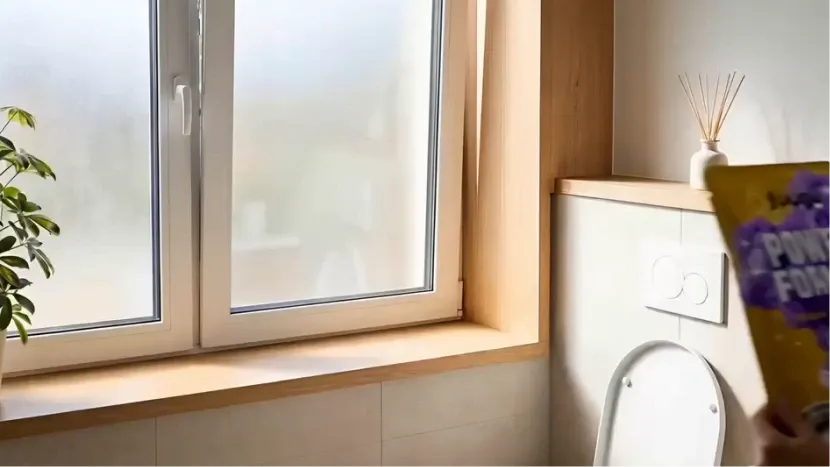
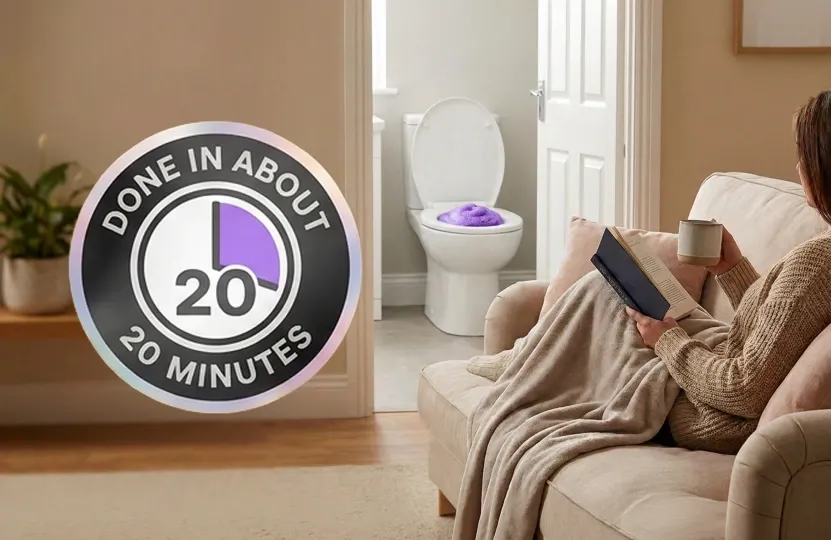
Pour, close the lid, come back after about 20 minutes, flush – the whole routine (vendor images).
Unboxing and first impression
The parcel arrived twelve business days after ordering, with tracking – within the stated window, but not fast. Inside: six small boxes with two pouches each, no bottle, no plastic scoop, very little packaging volume. The pouches are matte, tear open easily at a notch and contain a fine purple-flecked powder with a faint citrus smell. No instructions beyond the box, but there is nothing to get wrong: one pouch, one bowl. Our first pour, in bathroom A: the powder hits the water, there is a soft hiss, and within about 30 seconds a purple dome starts rising. After two minutes it had reached the underside of the rim on three sides and was clearly standing on the porcelain rather than sloshing in the water. We closed the lid and set a timer.
Bathroom A: the years-old hard-water ring
Starting point: a dark grey ring about one centimetre wide at the waterline, rough to the touch, and brown crust under the rim jets – the kind of toilet a landlord points at. After 20 minutes and one flush, the ring was visibly lighter and the crust under the rim had softened; a fingertip (gloved) could rub some of it off, which it couldn’t before. We did not rub – the rule was no scrubbing. Treatment two, a week later: the ring was down to a thin, pale line, the rim crust mostly gone. Treatment three: no ring visible from a standing position; up close, a very faint shadow at the waterline remained. Treatment four kept it that way. A bonus we hadn’t expected: the flush was noticeably stronger from week two, and water came out of all the rim jets again, including two that had been half blocked. Verdict for A: a ring that had beaten two gels and years of scrubbing was gone after three pouches, with a brush that never left its holder.
Bathroom B: weekly maintenance in medium water
The family house was the easy case and the most realistic one for most buyers: two toilets, cleaned every weekend, no serious ring but the usual faint waterline and the beginnings of a grey line under the rim. One pouch per toilet per week kept both bowls clean for four weeks without brushing – the waterline simply didn’t come back. The family’s comment after week two was telling: the children’s bathroom, previously the one everyone avoided, stopped smelling “like a toilet”, which fits the vendor’s claim that odour lives in the scale rather than in the water. One observation about foam height: the downstairs toilet is a modern rimless model with a low water level, and the foam filled it right up to the top edge; the upstairs toilet is an older deep bowl with a high water line, and there the foam reached about two thirds of the height before stopping. The area above it had less scale anyway, but it is the one case where a quick wipe with the brush would still make sense.
Bathroom C: rust streaks from well water
Iron is a different problem from limescale, and this was the test we expected Fuugu to lose. Starting point: orange-brown streaks running from each rim jet down to the water, and an orange tide mark. Treatment one removed the tide mark completely and faded the streaks to a light tan. Treatment two took most of the streaks; a faint trace remained at the top of two jets where the foam had been thinnest. Treatment three left them barely visible. That is slower than on limescale – citric acid binds iron, but it needs time – and a very old, thick rust deposit will probably need more patience than four weeks. Still: no brush, no pumice, no scratches on the glaze.
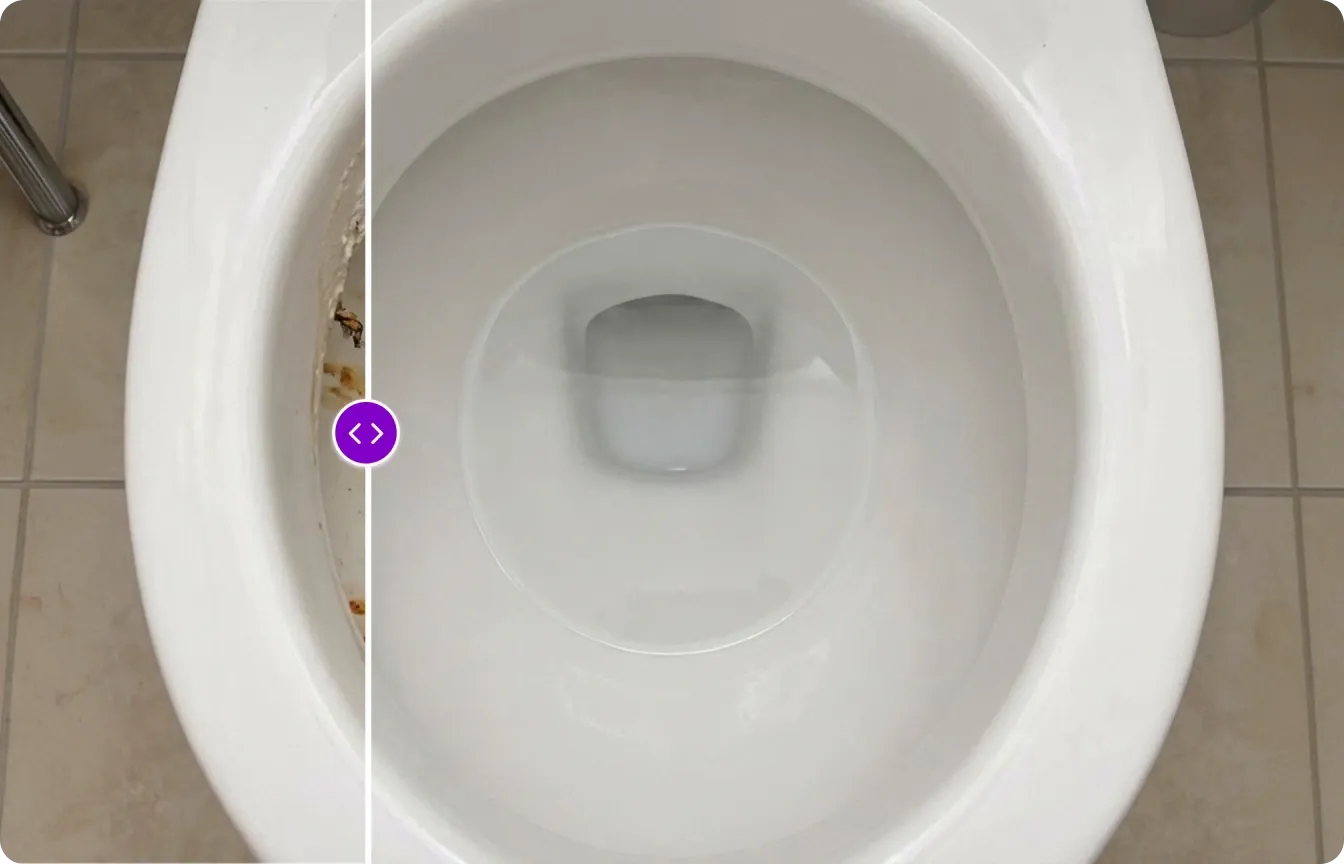
The result the vendor promises – and what we saw in bathrooms A and B after three weekly treatments (vendor image).
Bathtub, sink, kitchen drain, smell, residue
We also tried the “one pour for every ring” claim. In the bathtub it works, but awkwardly: the foam needs water to react, so you have to run a few centimetres of water, sprinkle the powder along the waterline and spread the foam with a wet cloth – the grey ring came off with a wipe afterwards, but “no scrubbing” is a stretch here. In the bathroom sink it was better: half a pouch in a sink with the plug in and a little water produced enough foam to cover the basin and clear the limescale spots around the drain and the overflow. In the kitchen drain it foamed up out of the plughole and, after rinsing, the sour smell that had been coming from the drain was gone for the rest of the test. In all cases we rinsed thoroughly afterwards, as the label says. Smell during use: faint, slightly citrusy, no stinging, no need to open a window. Residue: none; the powder dissolved fully even in the cold-water cistern feed of bathroom A. Surfaces: we kept it well away from the marble windowsill in bathroom B – acids etch natural stone – and had no issues with chrome, acrylic or sealed tiles.
Fuugu does what the product page shows: the foam climbs, holds and dissolves. On a fresh or moderate waterline ring, one pouch is enough; on a neglected hard-water ring you need three, on rust streaks three or more – but you get there without a brush. The weekly routine takes less than a minute of hands-on time. The foam reaches less far in deep bowls with a high water level, and the product does nothing for the seat, lid, hinges and the outside of the toilet, which still need a wipe. Odour genuinely disappears with the scale. For anyone who hates scrubbing, has hard water, lives with a septic tank or simply wants the bleach smell out of the house, this is one of the few “as seen online” cleaning products that holds up.
What Fuugu can’t do – an honest list
A good score needs clear limits. Here is what Fuugu is not, and what you should know before ordering:
- It is not a disinfectant. Fuugu contains no biocides, by design – the vendor’s own FAQ calls it “a cleaner, not a disinfectant”. It removes the scale that odours and bacteria live in, but it does not sanitise the bowl. If you want that, use a separate product on a different day – never mix acid and chlorine bleach.
- “Stains gone in seconds” is marketing; “gone in three weeks” is reality for old rings. A fresh waterline ring disappears in one treatment. A years-old, thick limescale ring took three weekly pouches in our test, rust streaks three or more. The vendor’s own FAQ admits heavy rings may need a second pouch.
- Foam height depends on the bowl. In rimless and low-water bowls the foam reached the rim; in a deep bowl with a high water line it stopped at about two thirds. The vendor says the same in its FAQ. Scale above that line still needs a wipe.
- It cleans the inside of the bowl – nothing else. Seat, lid, hinges, the outside and the floor around the toilet still need a cloth. “The last day you own a toilet brush” is true for the bowl, not for the bathroom.
- Not for natural stone, marble or unsealed surfaces. Citric acid etches them. Keep it in the bowl, tub, sink and drain, and rinse afterwards. Bathtub use needs a little water and a wipe – it is not as effortless as the toilet.
- Per clean, it costs more than gel. At €6.95 to €14.95 per pouch, a weekly clean costs several times what a squirt of supermarket gel costs. You pay for the no-scrub convenience and the descaling; if you have soft water and don’t mind the brush, a gel is cheaper.
- Vendor claims are vendor claims. “4.5/5 from 9,754 reviews”, “Cleans 100 %”, “99 % odour source neutralisation”, the “As seen in” media logos, the “chemical expert” quote (who appears under a different surname on the German version of the page), the “386 items sold in the last 60 minutes” ticker and the permanently restarting “70 % off” countdown are marketing devices without a verifiable source. The product is good; the page oversells it.
- Shipping and refunds. The company ships from Lithuania: dispatch in 1–2 business days, delivery around 10–14 business days to most European countries (8–12 to the Netherlands, 14–18 to Israel), customs possible outside the EU. The 60-day guarantee is real, but after the 14-day withdrawal period only the product price is refunded, not the original shipping, and return postage is at your cost. Returns need an RMA via the contact form first.
- No full ingredient list. Citric acid, foam builder, stabiliser and chelant are named; the exact surfactant, chelant, pH and pouch weight are not. A safety data sheet isn’t linked on the page.
None of this makes Fuugu a bad product – it is a very good descaling foam sold with a loud sales page. The score of 8.3 reflects both: a cleaner that did exactly what it should in three real bathrooms, and a price and marketing style you should go into with open eyes.
Our rating in detail
What speaks for Fuugu
|
What you should know
|
The deductions are for price per clean, the missing full ingredient list, the overselling on the product page and the slow shipping – not for the cleaning itself. Company details, phone numbers, a contact form, tracking and written shipping and refund policies are all in place. In the category “no-scrub toilet descalers” Fuugu is, in our experience, among the few that deliver on the video.
Fuugu vs. bleach gel, cleaning tablets, vinegar & baking soda, descaler
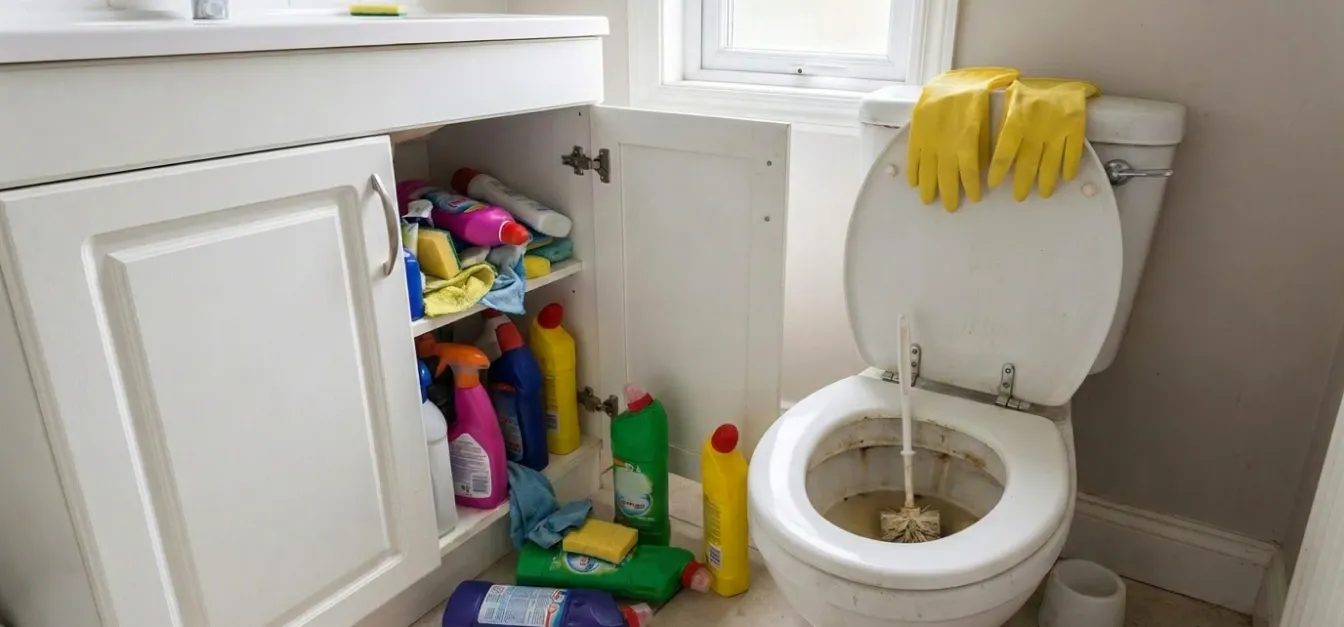
The usual arsenal: gels, bleach, sprays, tabs – most of them fight the colour, not the scale.
“Best toilet bowl cleaner for hard water”, “how to remove limescale from toilet”, “toilet cleaner without bleach”, “no scrub toilet cleaner” – the searches show what people are really after. This is how Fuugu compares with the alternatives, based on our test and general product knowledge:
| Solution | Removes limescale? | Scrubbing | Our take |
|---|---|---|---|
| Fuugu foam pouch | Yes – citric acid with ~20 minutes of contact time above the waterline | None in the bowl | The only option here that reaches under the rim without a brush. Best for hard water, septic tanks, anyone who can’t or won’t kneel. Most expensive per clean. |
| Bleach-based gel | No – lightens the colour, scale stays | Yes | Cheap, disinfects, smells of chlorine; the ring comes back. Fine for soft water and quick sanitising, wrong tool for limescale. |
| Acidic “limescale” gel | Partly – only where it stays, i.e. at the bottom | Yes, to keep it on the ring | Right chemistry, wrong physics: runs off the waterline in seconds. Works if you brush it onto the ring repeatedly. |
| Fizzing tablets / “bombs” | Weakly – fizz collapses quickly | Usually | Fun to watch, cheap, mostly deodorise. Foam deflates before it has done much; many are bleach-based. |
| Vinegar & baking soda | Weakly – diluted instantly, sits at the bottom | Yes | The famous hack neutralises itself (acid + base) and never reaches the rim. Vinegar alone, left overnight with the water bailed out, does work – with effort. |
| Pumice stone | Yes – mechanically | Heavy | Removes anything, including the glaze if you’re not careful. Scratched porcelain scales up faster afterwards. |
| Professional descaler (hydrochloric acid) | Yes – fast | Little | Strongest option for a neglected bowl, but fumes, gloves, goggles, not septic-friendly, and it still runs off the ring. For the one-off rescue, not the weekly routine. |
Our conclusion: for a bowl in soft water that is cleaned weekly anyway, a cheap gel and a brush are hard to beat on cost. For hard water, rust, septic tanks, rental properties, elderly or mobility-limited users and anyone who wants the brush gone, Fuugu is the most convenient effective option we have tried – with the one-off professional descaler as the alternative for a truly neglected bowl you want fixed in an afternoon.
How to use Fuugu correctly – step by step
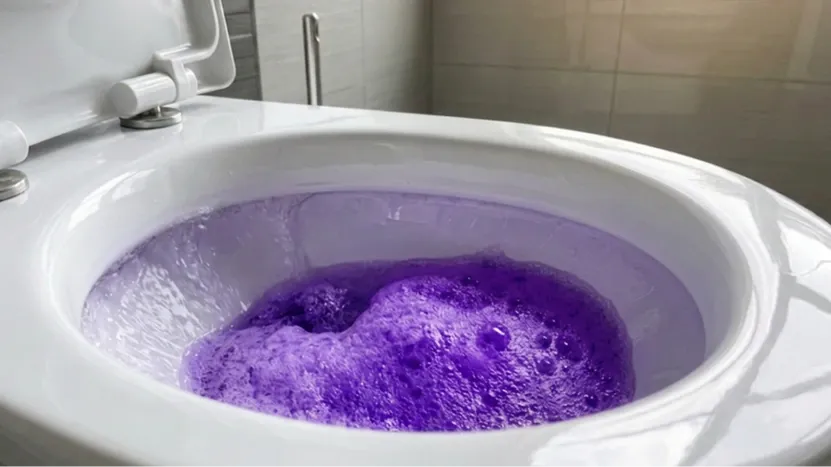
Purple means it’s holding and working – the foam should stand on the walls, not sit in the water (vendor image).
- Flush first. Fresh, cold water in the bowl is fine – the powder is designed for cold water. Don’t add anything else, especially not bleach.
- Tear and pour one pouch. Pour the powder evenly around the bowl, not in one spot, so the foam rises on all sides. Aim for the waterline and the area below the rim.
- Close the lid and wait around 20 minutes. The vendor says 20; we got slightly better results on the old ring in bathroom A with 30. Don’t flush early, and don’t use the toilet in the meantime.
- Flush. That’s it. On a normal bowl there is nothing left to do. On a very old ring, a second pouch a week later is part of the plan – not a sign that it didn’t work.
- Deep bowl, high water line? If the foam stops short of the rim, give the area above it a quick wipe with the brush after the treatment – the softened scale comes off easily. Or lower the water level once by pouring a bucket of water into the bowl quickly before you add the pouch.
- Weekly, one pouch per toilet. That is the maintenance dose. In soft water you can stretch it to every two weeks; in very hard water stick to weekly.
- Tub, sink, drain: a little water, sprinkle, let it foam, wipe, rinse thoroughly. Keep it away from marble, natural stone and unsealed grout. Store the pouches dry – it’s a powder that reacts with water.
- Safety: It’s an acid, not food. Keep away from children and pets, don’t inhale the powder, rinse skin if it gets on it, and don’t combine it with chlorine cleaners in the same bowl.
Who Fuugu is for – and who should skip it
Fuugu makes sense for you if:
- You live in a hard-water area and the ring comes back within days whatever you do.
- You have rust or iron stains from well water or old pipes.
- You have a septic tank or a small sewage treatment plant and want to keep bleach and biocides out of it.
- You can’t or don’t want to kneel and scrub – older people, people with back or knee problems, pregnant women, anyone who simply hates the job.
- You manage several toilets – holiday rentals, a shared house, a small office – and want a routine that anyone can follow in 30 seconds.
- Chlorine fumes bother you or someone in the household (asthma, small children, pets).
You can skip it if:
- You have soft water, no ring, and the weekly brush doesn’t bother you – a cheap gel will do the same job for a fraction of the price.
- What you actually want is disinfection (e.g. after illness) – Fuugu isn’t that.
- You expect a years-old crust to vanish in 20 minutes – plan for three weeks or use a professional descaler once first.
- You need it tomorrow – delivery from Lithuania takes around two weeks.
Fuugu reviews and customer experiences: what buyers report
The product page shows a rating of “4.5/5 from 9,754 reviews” and a carousel of five-star testimonials. We can’t verify that number, and a vendor naturally shows its best feedback – so treat it as advertising. What we can do is compare the themes in those testimonials with our own four weeks, and with what people tend to say about foaming toilet cleaners in general:
| What customers say (vendor page) | Does it match our test? |
|---|---|
| “Scrubbed our hard-water ring every week for years – poured one bag, flushed, the ring was basically gone.” | Yes for a moderate ring; our years-old ring needed three pouches, not one. |
| “Bought it for my elderly mother who can’t kneel and scrub anymore – she does it all herself.” | Yes – this is the strongest use case. Tear, pour, flush later; no bending at all. |
| “The foam really climbs under the rim like in the video. No bleach smell.” | Yes in rimless and low-water bowls; in a deep bowl it stopped at about two thirds. No bleach smell is accurate. |
| “We’re on well water – first treatment took most of it off, after the third weekly bag the crust was gone.” | Matches bathroom C almost exactly. |
| “Took two treatments to clear a really old rust streak – not instant magic on everything, but way better than anything else.” | The most honest review on the page, and the one we would sign. |
| Typical criticism of foaming cleaners elsewhere: “expensive per use”, “delivery took two weeks”, “didn’t reach the top of the bowl” | All three apply to Fuugu too – we’ve listed them under limits. |
The pattern in positive Fuugu reviews is consistent: hard water, septic tank, no more kneeling, no chlorine smell. The pattern in negative experiences with this type of product is equally consistent: price per pouch, shipping time, and expectations of a single-treatment miracle on a decade of scale. If you know both going in, you are unlikely to be disappointed.
Is Fuugu legit? Company, support and guarantee
Countdown timers and “386 items sold in the last 60 minutes” tickers make a lot of shoppers wonder whether Fuugu is legit before they order. What we found: the shop is operated by UAB Domestica, a limited company registered in Lithuania (company number 307174704, VAT ID LT100018934013), with a published shipping policy, a returns and refunds policy, terms of service, an about-us page, a contact form and telephone numbers for Germany (+49 800 400 9820, a free 0800 number), the UK (+44 20 8089 1401) and the US (+1 337 458-4009). The contact page promises a reply from “a real human” within three business days. Orders come with tracking. Payment runs through standard card processing, Klarna and Apple Pay – no bank transfer in advance, no crypto.
The 60-day money-back guarantee is written down in the returns policy, with a catch you should know: within the first 14 days after delivery you have the EU right of withdrawal and get the full purchase price including the original shipping back (return postage at your cost); from day 15 to day 60 the vendor’s own guarantee applies, which refunds the product price but not the original shipping. Returns need an RMA number first – you request it through the contact form, and the parcel has to be sent with tracking. That is a normal, fair policy; it just isn’t the “one click” the product page suggests. The product itself is real, arrived as described, and did what the video shows. In short: a real company with an aggressive sales page – not a scam.
Where to buy: Amazon, supermarket or the official shop?
Fuugu is sold directly through the official shop at get-fuugu.com. We found no listing on Amazon, eBay or in supermarkets, and the vendor itself warns of imitations (“Fuugu clones”) – foaming toilet powders from other brands exist, with varying formulas, some of them bleach-based. If you see “Fuugu” offered elsewhere at a suspiciously low price, check the seller. Three practical reasons for the official shop: the 60-day guarantee only applies to orders placed there; the pack prices (from €6.95 per pouch) are only available there; and support, tracking and the RMA process run through the same company that ships the product. The checkout detects your country and shows prices in your local currency – you can’t change the currency manually, and the delivery country only affects the shipping time.
Prices, packs, shipping and the 60-day guarantee
These are the prices we saw in the official checkout in October 2026 for a delivery address in Germany, shown in euros. The product page advertises “70 % off the Month Pack”; the “original” prices crossed out in the checkout are vendor figures. What matters is the price you actually pay per pouch:
| Pack | Price | Per pouch | Lasts (1 toilet, weekly) |
|---|---|---|---|
| 2 pouches (1 box) | €29.90 (crossed out: €46.33, “−35 %”) | €14.95 | 2 weeks – only for trying it out |
| 4 pouches (“Month Pack”) | €51.80 (crossed out: €92.68, “−44 %”) | €12.95 | 1 month |
| 8 pouches | €71.60 (crossed out: €185.32, “−61 %”) | €8.95 | 2 months |
| 12 pouches (“Most Popular”) | €83.40 (crossed out: €277.98, “−70 %”) | €6.95 | 3 months – or 6 weeks for two toilets |
Plus shipping: standard €5.95 (express available at extra cost). Payment by credit or debit card, Klarna or Apple Pay. It is a one-time purchase – there is no subscription, nothing is pre-ticked in the checkout, and no extended warranty is pushed. Our recommendation: the 2-pack is poor value (€14.95 per pouch) and only makes sense as a sample; the 12-pack halves the per-pouch price and covers one toilet for three months or two toilets for six weeks, which is roughly what you need to clear a bad ring and keep it away. With the 60-day guarantee the bigger pack carries little extra risk.
- Shipping: dispatch within 1–2 business days; delivery around 4–14 business days depending on the country – 10–14 to Germany, Austria, France, Italy, Spain, Sweden, Norway, Finland, Denmark, Hungary, Romania, Greece and Turkey, 8–12 to the Netherlands, 14–18 to Israel. Outside the EU, customs charges are possible. Ours took 12 business days to Germany.
- Guarantee & returns: 60 days. Days 1–14: EU withdrawal, full refund including original shipping, return postage at your cost. Days 15–60: vendor guarantee, product price refunded, original shipping not. RMA via the contact form, reply within 3 business days, return with tracking.
- Support: contact form at get-fuugu.com/contact; phone +49 800 400 9820 (DE), +44 20 8089 1401 (UK), +1 337 458-4009 (US); UAB Domestica, Lithuania, company number 307174704.
Frequently asked questions about Fuugu
What exactly is Fuugu?
A foaming toilet bowl cleaner in pre-dosed powder pouches. Poured into the bowl, the powder turns into a dense purple foam that climbs the walls and holds under the rim for about 20 minutes while citric acid dissolves limescale, hard-water rings and rust. Then you flush. It contains no chlorine bleach, ammonia, quats or biocides and is septic-safe when used as directed.
Does Fuugu really work without scrubbing?
In our four-week test, yes: a fresh waterline ring disappeared after one treatment, a years-old hard-water ring after three weekly pouches and rust streaks faded to barely visible after three – with the brush untouched. The exception is the upper part of deep bowls with a high water line, where the foam reached about two thirds of the way up and a quick wipe helped.
How long does it take?
About 20 minutes of waiting with the lid closed, plus under a minute of hands-on time. On very old scale we left it for 30 minutes with slightly better results. Don’t use the toilet in between.
How often should I use it?
The vendor recommends one pouch per toilet per week. That kept both toilets in our medium-water test house ring-free for four weeks. In soft water, every two weeks is enough; in very hard water, stay weekly. For a bad ring, plan on three consecutive weekly treatments.
Is Fuugu safe for septic tanks and pipes?
According to the vendor, yes: no chlorine bleach, no biocides, no quats, so the bacteria in a septic tank are not harmed when it is used as directed (one pouch per toilet per week). Citric acid and the chelant are standard in septic-safe descalers. We saw no issues with chrome, acrylic or sealed tiles; it is not suitable for natural stone, marble or unsealed surfaces.
Does it disinfect?
No. Fuugu descales and removes the scale that odours live in, but it contains no disinfectant. If you want to sanitise the bowl, use a separate product on a different day – never together with Fuugu, because acid and chlorine bleach must not be mixed.
Does it smell of bleach?
No. There is a faint, slightly citrusy smell while it foams and nothing afterwards. There is no perfume either – the bowl just stops smelling, because the odour source (the porous scale) is gone.
Can I use Fuugu in the bathtub, sink or kitchen drain?
Yes, the vendor lists all three. In our test it worked well in the sink and the kitchen drain and reasonably in the bathtub, where you need a little water and a wipe. Rinse surfaces thoroughly afterwards and keep it off marble and natural stone.
What does Fuugu cost?
In the official shop (October 2026, prices shown in euros for a German address): 2 pouches €29.90, 4 pouches €51.80, 8 pouches €71.60, 12 pouches €83.40 (€6.95 per pouch) – plus €5.95 standard shipping. One-time purchase, no subscription. The checkout shows prices in your local currency.
Is Fuugu available on Amazon or in shops?
No. Fuugu is sold through the official shop only. Other foaming toilet powders exist under different brand names with different formulas, some bleach-based. The 60-day guarantee applies to orders from the official shop.
How long does delivery take?
Dispatch within 1–2 business days, delivery around 10–14 business days to most European countries (8–12 to the Netherlands, 14–18 to Israel), with tracking. Our parcel took 12 business days to Germany. Customs charges are possible outside the EU.
How does the 60-day guarantee work?
Request an RMA number through the contact form (reply within 3 business days), send the parcel back with tracking. Within 14 days of delivery you get the full price including original shipping back; from day 15 to 60 the product price only. Return postage is at your cost in both cases.
Is Fuugu legit or a scam?
Legit. The shop is run by UAB Domestica, a registered Lithuanian company with company number, VAT ID, phone numbers in three countries, a contact form, tracking and written policies. The product arrived and worked as shown. The sales page – countdowns, sold-tickers, media logos, unverifiable review counts – is aggressive marketing, not fraud.
Has Fuugu been tested by a consumer organisation?
We are not aware of any test of Fuugu by Which?, Stiftung Warentest or a comparable consumer body. Our score is based on our own four-week practical test and the vendor’s published information.
Our verdict
Fuugu is one of the rare “as seen online” cleaning products that does what its video shows. The purple foam climbs, holds under the rim and dissolves limescale and rust instead of bleaching the colour – and it does so without a brush, without chlorine fumes and without harming a septic tank. In three real bathrooms it removed a fresh ring in one treatment, a years-old hard-water ring in three and rust streaks in three or more, cleared the rim jets and took the toilet smell out of a children’s bathroom. The weekly routine takes less than a minute. Score 8.3/10 – very good.
Being honest: Fuugu descales, it doesn’t disinfect; old rings take weeks, not seconds; the foam reaches less far in deep bowls; it only cleans the inside of the bowl; and per clean it costs more than supermarket gel. The product page oversells with countdowns, media logos and review counts nobody can check, and delivery from Lithuania takes around two weeks. If you have hard water, rust, a septic tank, bad knees or simply no patience for the brush – and you buy the 12-pack to get the price down to €6.95 per pouch – Fuugu is, in our experience, the most convenient effective toilet cleaner you can order right now. With 60 days to send it back, the risk is small.
More information on ingredients, use, shipping and returns is available on the official Fuugu website.
Transparency notice: This article contains affiliate links. If you order through one of these links, we receive a commission – the price for you does not change, and our rating is not influenced by it. Information on ingredients, effectiveness, customer numbers and reviews comes from the vendor. Fuugu is an acidic cleaner: keep away from children and pets, do not mix with chlorine-based products, not suitable for natural stone, marble or unsealed surfaces, rinse surfaces after use and follow the directions on the label. It does not disinfect. Brands mentioned serve only as a comparison. Prices and discounts as shown in the vendor’s shop in October 2026 for a delivery address in Germany, displayed in euros; the shop shows prices in your local currency; subject to change.

- Fuugu Toilet Bowl Cleaner Review 2026: Does the Purple No-Scrub Foam Really Work? Test, Price & Verdict - 26. October 2026
- Wellnee Knee Brace Reviews – The best Knee Sleeve at the cheapest price - 16. April 2025
- Wellnee Herbal Pain Relief Knee Patches – Reviews (UK, Australia, USA, Canada) - 24. March 2025


