

WellHeater Reviews 2026: Is the 800-Watt Plug-In Wall Heater Legit? Our Test, Electricity Cost, Price & Honest Verdict
Almost every home has one: the room that never quite warms up – the home office at the end of the hall, the bathroom that feels like a fridge at 6:30 a.m. Turning up the whole-house thermostat for one cold room is expensive. WellHeater – searched for as “WellHeater reviews”, “well heater”, “get wellheater” and in variants and misspellings like “wellheater heater”, “well-heater” or “wel heater” – promises a neater answer: a compact ceramic heater that plugs straight into the wall outlet, with two heating modes, thermostat, timer, remote control and touch display. We used it for three weeks in a home office, a bathroom and a bedroom – and once where it was never meant to shine, a full-size living room. Below: what the plug-in heater does in everyday use, the honest physics behind “saves energy”, what an hour on 400 W or 800 W really costs, the real prices including shipping, the return policy – and our answer to the question: is WellHeater legit?
- 🏆 Our verdict: WellHeater plug-in wall heater – 8.0/10, good. Compact ceramic fan heater that plugs directly into a standard wall outlet – no cord, no stand; per the vendor two modes (400 W / 800 W), thermostat, timer, remote and touch display, overheat protection and automatic shut-off; for rooms up to 130 sq ft (12 m²) per unit; 30-day money-back guarantee.
- Strengths: In our test it took the chill out of a small home office and a cold bathroom quickly, without cable clutter; simple remote and touch display, a timer to heat only when needed; low mode suits long desk sessions; moves between rooms in seconds; from $34.37 per unit in the 4-pack.
- To be honest: 800 W is small-room heat – no replacement for your furnace. Like every electric resistance heater it turns electricity into heat at practically 100 %; savings come from heating one room instead of the whole house, not from the efficiency graphics on the product page. No published technical data sheet (voltage, IP rating, certification marks). Per the vendor FAQ it doesn’t switch off at the set temperature – use the timer. Needs a free wall outlet in the right spot; audible fan hum.
- Price (official checkout, October 2026, USD): 1 unit $49.99 · 2 units $89.70 ($44.85 each) · 3 units $112.47 ($37.49 each, “Best seller”) · 4 units $137.48 ($34.37 each) – plus $7.95 shipping on every pack; optional extended warranty $4.99 per unit. One-time purchase, no subscription. Sold through the official website only.
WellHeater at a glance: product, fact sheet, verdict
|
🏆 Verdict: good
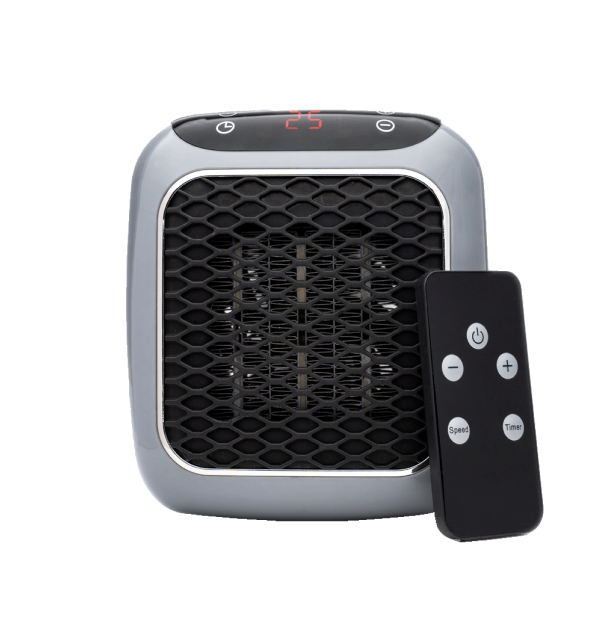 WellHeater Plug-In Wall Heater★★★★☆
Score 8.0/10 · good
Price: from $34.37 per unit
1× $49.99 · 2× $89.70 · 3× $112.47 · 4× $137.48 plus $7.95 shipping |
Fact sheet according to the vendor
|
Prices from the official checkout for a US delivery address (USD, excluding $7.95 shipping), October 2026. Technical details are vendor information.
- What is the WellHeater – and how does a plug-in wall heater work?
- The cold-room problem: why heating the whole house for one room costs so much
- Technology: ceramic plates, fan, thermostat – and the truth about “energy saving”
- How much electricity does the WellHeater use? Running costs explained
- Room size: how many WellHeaters do you need?
- How we tested
- WellHeater in practice: home office, bathroom, bedroom
- What the WellHeater can’t do – an honest list
- Our rating in detail
- WellHeater vs. space heater, oil-filled radiator, fan heater, central heating, heat pump
- How to use the WellHeater safely – step by step
- Who the WellHeater is for – and who should skip it
- WellHeater reviews and complaints: what customers report
- Is WellHeater legit or a scam? Company, checkout and support
- Where to buy: Amazon, Walmart, Home Depot or the official website?
- WellHeater price: packs, shipping and the 30-day guarantee
- Frequently asked questions (FAQ)
- Our verdict
What is the WellHeater – and how does a plug-in wall heater work?
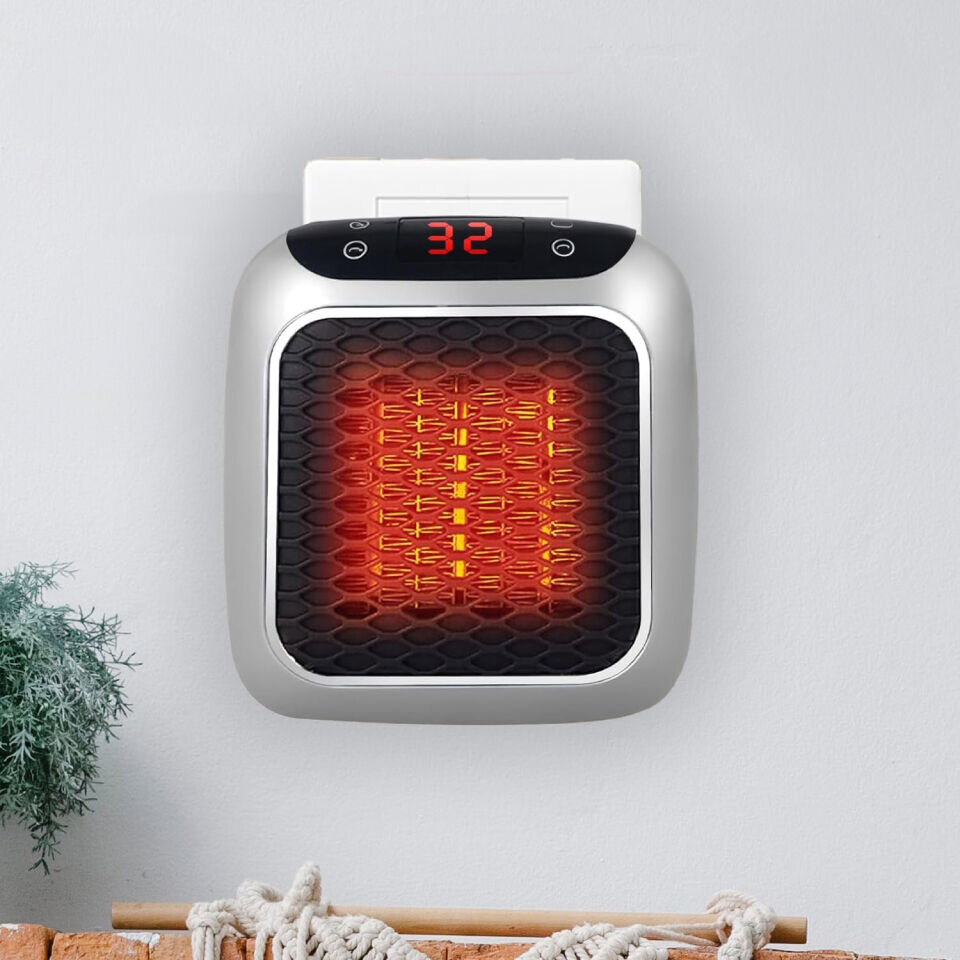
No cord, no stand, no footprint: the whole WellHeater sits on the wall outlet (vendor image).
WellHeater is a compact electric heater that doesn’t stand on the floor or sit on a desk – the entire unit plugs directly into a wall outlet, and that is also how it is held in place. The category is called a “plug-in heater”, “plug-in wall heater” or “wall outlet heater”, and it is popular because it needs no floor space, has no cord to trip over and moves from room to room in seconds. The brand sells it direct-to-consumer through get-wellheater.com.
Inside, according to the vendor, it works like a miniature ceramic fan heater: ceramic heating plates get hot, and a small fan blows room air across them and back out through the grille. There are two modes – low at 400 W (“slow wind for gradual warmth”) and high at 800 W (“strong wind for instant heat”) – plus an adjustable thermostat, a timer, a remote control and a touch display with a digital temperature read-out. The vendor also lists overheat protection, an automatic shut-off, a housing that “stays cool to the touch” (the grille does get warm) and an “antimicrobial air filter”.
What it is meant for is spelled out on the product page: rooms up to 130 sq ft (12 m²) per unit – a small bedroom, home office, bathroom or dorm room. It is a spot heater for the room you are in, not a whole-house heating system. That distinction matters for everything in this WellHeater review, especially for electricity costs.
A note for searchers: in the US, “well heater” is also a generic term for heaters that keep a water well or pump house from freezing. WellHeater has nothing to do with that – it is an indoor plug-in heater for dry living spaces.
The product page is enthusiastic – efficiency graphics, superlatives, “advanced heating technology” – without sources or reference points, so we treat those statements as marketing and explain below what an electric heater can and can’t do. Our questions were simpler: does it make a cold small room comfortable, is it easy and safe to live with, and what does it really cost?
The cold-room problem: why heating the whole house for one room costs so much
Most American homes are heated by a central system controlled by one thermostat in the hallway. But some rooms are always colder: the one above the garage, the corner room with two outside walls, the basement office, the bathroom with the drafty window. The usual fixes all have a catch:
- Turn the main thermostat up. Every extra degree heats every room – including the empty ones. If you work from home in one room all day, that is the most expensive solution.
- Use a classic space heater. Effective, but a typical floor or tabletop model draws around 1,500 W, needs a cord and clear space around it – and in a small bathroom or tight bedroom there often isn’t a safe spot.
- Put on a sweater. Free and often right – until you sit still at a desk for hours or step out of a hot shower into a cold room.
This is the gap a plug-in heater is designed for: zone heating. Instead of warming 1,500 or 2,000 square feet, you warm the 100 or 130 square feet you are actually using, for the hours you are in it – a home office during the workday, the bathroom for 20–30 minutes in the morning, the bedroom for an hour of reading, or the cool “shoulder season” weeks before the central heating goes on. That is the only honest source of savings with any electric heater – and it can be a real one. What a plug-in heater can’t do is change the physics of a badly insulated room: if heat leaks out faster than 800 W can supply it, the room stays cool.
Technology: ceramic plates, fan, thermostat – and the truth about “energy saving”
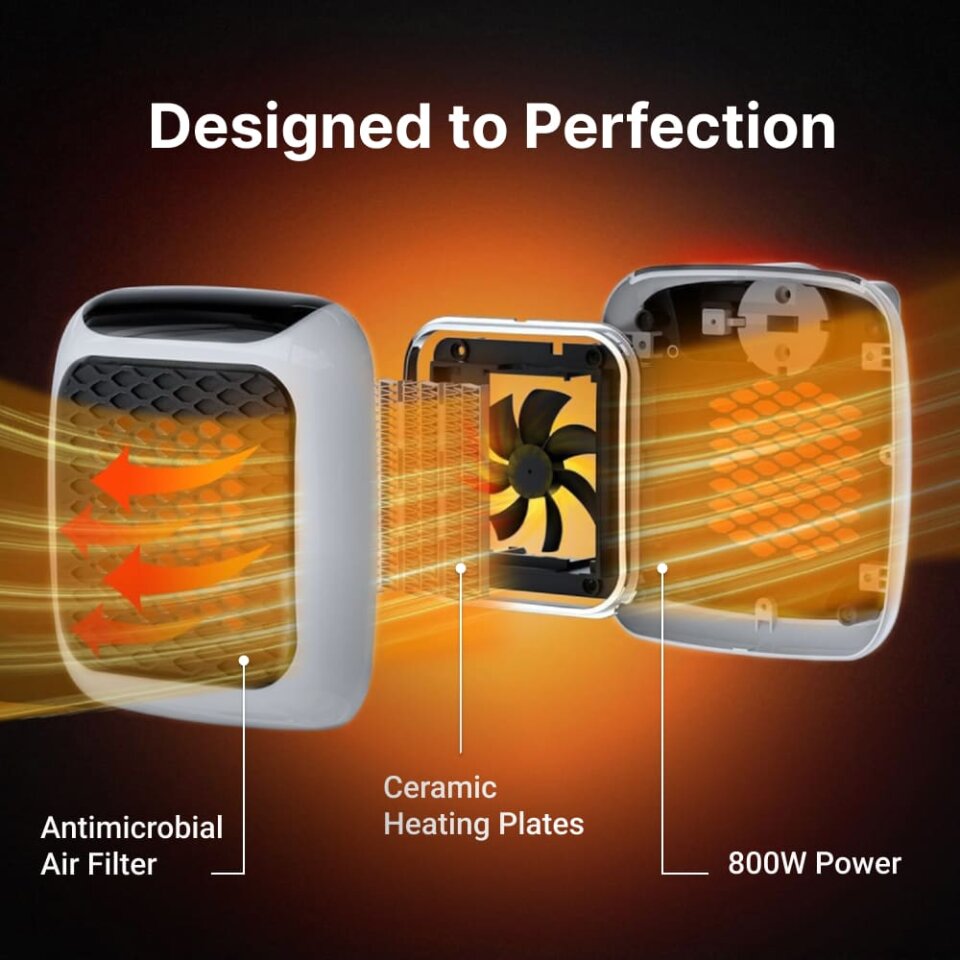
The vendor’s exploded view: filter, ceramic heating plates and fan in a compact housing (vendor graphic).
The vendor’s “Designed to Perfection” graphic shows the build: filter, ceramic heating plates, fan and control electronics in a housing that sits directly on the plug. Our assessment:
| Component | What the vendor says | Our assessment |
|---|---|---|
| Ceramic heating plates | “Advanced heating technology” | The standard in small fan heaters: they warm up quickly and pass heat to the air efficiently. Still resistance heating – no more heat per watt than any other electric heater. |
| Fan & two modes | Low 400 W, high 800 W | The fan makes it feel warm quickly by pushing warm air toward you. Two levels are useful: low for long sessions, high for a boost. |
| Thermostat | Set your desired temperature | Convenient as a comfort target – but per the vendor FAQ the heater doesn’t switch off when the temperature is met; the timer is recommended. How it regulates isn’t documented. |
| Timer, remote, touch display | Timer, remote control, digital temperature read-out | The most practical features: the timer for comfort, safety and your bill; the remote because wall outlets sit low on the wall. |
| Overheat protection, auto shut-off | Housing stays cool to the touch; “safe for the whole family” (vendor wording) | Important standard features – no substitute for a free grille, no long unattended use and supervised children and pets. |
| “Antimicrobial air filter” | “Removes bacteria, mold and allergens” while heating | A vendor claim we cannot verify. A small heater fan is not an air purifier; the filter does keep coarse dust away from the heating plates. |
| Efficiency claims | “Uses less electricity while providing maximum heat”; “53.9 % more heat”, “90 % less energy” | No reference point and no source. Physically, any electric resistance heater converts practically 100 % of its electricity into heat. |
| Not stated | – | Voltage, dimensions, weight, IP rating, certification marks, thermostat range, timer steps – check the rating label and the manual on delivery. |
Why no electric heater “saves” energy per watt
An electric resistance heater – wire coil, ceramic plate, oil-filled fins or quartz tube – turns its electricity into heat with practically 100 % efficiency: no loss up a chimney, and no bonus either. 800 watts of electricity become roughly 800 watts of heat. Only heat pumps deliver more heat than they use in electricity, because they move heat from outside.
Savings come from wattage × hours and the size of the space you heat. A 400- or 800-watt heater uses less electricity per hour than a 1,500-watt one – but it also delivers proportionally less heat, which is fine in a small room. And if it lets you keep the central heating lower while you sit in one warm room, your total energy use can fall. That is a legitimate benefit. “90 % less energy” only makes sense when comparing one small room with a whole house – not as a statement about the device.
How much electricity does the WellHeater use? Running costs explained
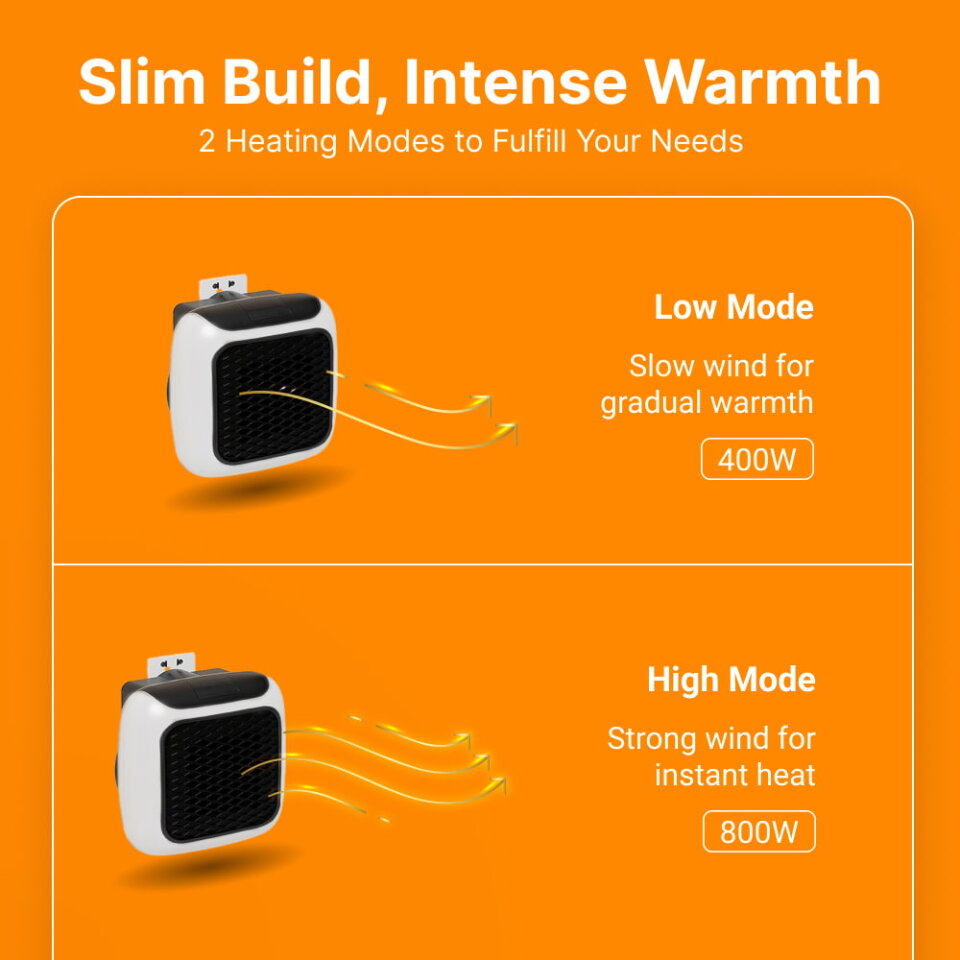
Two power levels: 400 W for gradual warmth, 800 W for a quick boost (vendor graphic).
“How much electricity does a space heater use?” is one of the most-searched heating questions in the US. For the WellHeater the power draw is known – 400 W on low, 800 W on high – and the formula is the same for every electric heater:
Cost = power in kilowatts × hours of use × your electricity price per kWh
Your price per kWh is on your electric bill and varies by state, utility and plan. For the examples below we use 17 ¢ per kWh purely as an example price – not as a national average:
| Scenario | Mode & time | Electricity | Cost at the example price of 17 ¢/kWh |
|---|---|---|---|
| 1 hour on high | 800 W × 1 h | 0.8 kWh | ≈ 14 ¢ |
| 1 hour on low | 400 W × 1 h | 0.4 kWh | ≈ 7 ¢ |
| Bathroom, morning boost | 800 W × 30 min daily, 30 days | 12 kWh | ≈ $2.04 per month |
| Bedroom, evening reading | 800 W × 1 h daily, 30 days | 24 kWh | ≈ $4.08 per month |
| Home office, low mode | 400 W × 6 h, 22 workdays | 52.8 kWh | ≈ $8.98 per month |
| Home office, high mode | 800 W × 6 h, 22 workdays | 105.6 kWh | ≈ $17.95 per month |
| Left on around the clock | 800 W × 24 h | 19.2 kWh | ≈ $3.26 per day – why the timer matters |
These figures assume full power the whole time. Many thermostat heaters cycle down once a room is warm, so they use less. For the WellHeater, the vendor FAQ says it doesn’t switch off at the set temperature – so for budgeting, assume full power for as long as the timer allows.
Will a plug-in heater lower your electric bill?
It can – indirectly. Per hour, the WellHeater costs the same as any other 800-watt heater. Your bill goes down if it replaces something more expensive: keeping the central thermostat a few degrees lower during the day and warming only the home office, or bridging cool fall evenings without switching the central heating on. If you run it on top of an unchanged heating schedule, it simply adds 0.4 or 0.8 kWh per hour. A typical 1,500-watt space heater uses almost twice as much electricity per hour as the WellHeater on high – and delivers almost twice as much heat. Lower wattage means a lower bill per hour, not cheaper heat.
Room size: how many WellHeaters do you need?

Zone heating: one unit for the room you use, not one device for the whole home (vendor image).
One WellHeater is designed for a room up to 130 sq ft (12 m²) – roughly 10 × 13 ft. With normal ceilings, a closed door and reasonable insulation, 800 W is realistic supplementary heat there; in a bigger or drafty room it only takes the edge off near the heater.
The order page labels the packs by area: 1 unit “medium room up to 130 sq ft / 12 m²”, 2 units “large room up to 400 sq ft / 37 m²”, 3 units “small apartment up to 600 sq ft / 55 m²”, 4 units “small home up to 800 sq ft / 75 m²”. Those labels are generous: by the 130 sq ft per unit, two units correspond to about 260 sq ft, three to about 390 and four to about 520. We would think in rooms, not in total square footage:
- One unit: one small room you use regularly – home office, bathroom or bedroom.
- Two units: two small rooms, or one somewhat larger room with the heaters on different walls – on different outlets and, ideally, different circuits.
- Three or four units: one heater each in several small rooms, or a family splitting a pack – that is where the per-unit price of $37.49 or $34.37 pays off.
How we tested
We ordered the WellHeater through the official website like any customer and used it for three weeks in October in a single-family house – no lab measurements, just the criteria that matter in daily life:
- Heating performance in small rooms: how quickly the area around you feels warm, how evenly a small room warms up, low vs. high.
- Controls: thermostat, timer, remote and touch display in daily use.
- Ease of use and portability: plugging in, moving between rooms, outlet position.
- Safety features and documentation: what the vendor lists, how housing and grille behave, what the product page leaves out.
- Running cost and value for money: price per unit, shipping, electricity per hour.
- Transparency, seller and small print: company and checkout, support, shipping, guarantee and returns, advertising.
Test rooms: (A) a north-facing home office of about 10 × 12 ft (120 sq ft, 11 m²), used six to eight hours on workdays; (B) a small bathroom of about 6 × 8 ft (48 sq ft, 4.5 m²) with an outlet next to the door, well away from shower and sink; (C) a bedroom of about 11 × 12 ft (132 sq ft, 12 m²) used for evening reading; (D) for comparison, a living room of about 250 sq ft (23 m²) with a large window. October mornings were cool enough to want a sweater at the desk; our comfort target was around 68 °F (20 °C).
WellHeater in practice: home office, bathroom, bedroom
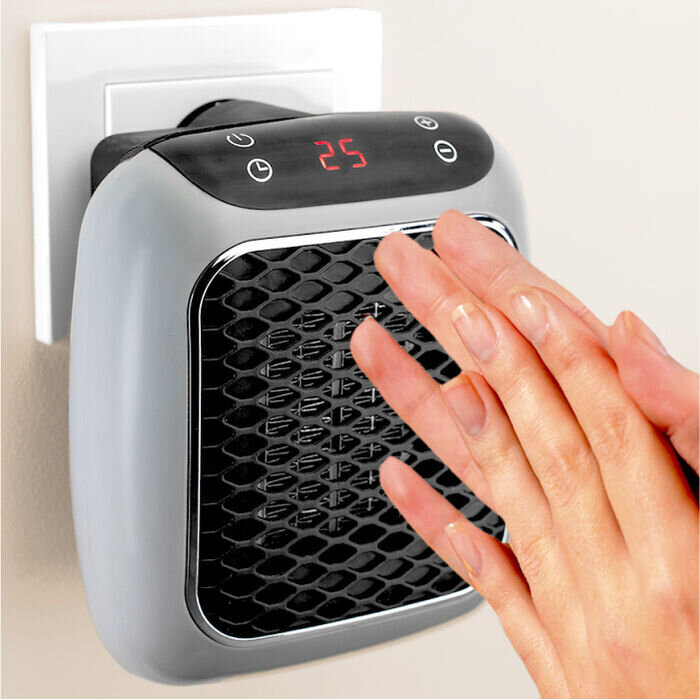
Touch display on the unit, remote control for the desk or the bed: the WellHeater’s controls (vendor image).
Unboxing and first impression
The parcel arrived within the delivery window stated in the shop’s shipping policy, with a tracking e-mail shortly after dispatch. Inside: the heater, the small remote control and a manual. The WellHeater is compact enough to hold in one hand, with the plug prongs integrated into the back of the housing, the grille for the warm air, and the display with the touch controls right on the unit. Workmanship looked tidy – no loose parts, no rattling, no plastic smell. We first read the manual and the rating label on the housing, and recommend every buyer does the same: since the product page publishes no data sheet, that is where the technical details and safety instructions are.
Plugging in: display, touch controls and remote
Setup takes as long as it sounds: push it into the outlet, switch it on. It sat firmly in all our outlets. The touch controls responded reliably to a light tap, and switching between low and high was immediately audible in the fan speed. The remote turned out to be the feature we used most: wall outlets in American homes sit close to the floor, and changing mode, target temperature or timer from the desk chair or from bed instead of bending down is a genuine comfort gain. It worked across each small test room without careful aiming – just give it a fixed place.
Thermostat and timer in daily use
We set the thermostat to around 68 °F (20 °C) and used the timer every single time – for a work block, for half an hour in the bathroom, for an hour of reading. That was the right habit: in our use, the heater kept blowing warm air after the room felt comfortable, consistent with the vendor FAQ – it doesn’t switch off when the set temperature is met, and the timer is the recommended way to stop it. (One vendor-published customer review says it does switch off; we would go by the FAQ.) No hardship: you know how long you will be in the room, and the heater switches itself off even if you have already left the house.
Home office: the strongest use case for a plug-in heater
Room A is the classic cold home office: north side, one outside wall, central heating set lower during the day, outlet under the desk at leg level. On high, warm air came out of the grille within moments, and after a few minutes there was a clear difference at the desk: the cold feet and chilly air around the legs, which usually send you to the hallway thermostat, were gone. The whole room took noticeably longer to lose its chill, and the corner by the window stayed the coolest spot – but after the first stretch on high we could switch to low and stay comfortable for hours. The vendor’s “heats the room in under 5 minutes” is a fair description of when you start to feel the warmth near the heater in a small, closed room – not of when the whole room is evenly warm.
Bathroom: a small space heater for cold mornings
“Space heater for bathroom” is one of the most-searched heater phrases in the US, and a heater without cord or footprint makes particular sense there – with one condition. Our bathroom (B) has an outlet next to the door, well away from shower, tub and sink, outside the splash zone. We switched the WellHeater on with the timer about 20 minutes before showering, on high, and stepping out into a room without that sharp chill was a small luxury we got used to quickly. In just under 50 sq ft, 800 W is plenty. Our routine: switch on and off only with dry hands, keep towels and bathrobes off the heater, let the timer end the session. US bathroom outlets are normally GFCI-protected (the ones with TEST and RESET buttons) – good, but it doesn’t make splash water acceptable. The product page doesn’t list an IP rating, so if your only bathroom outlet is next to the sink or tub, use the heater in another room.
Bedroom: an hour of warmth in the evening
In bedroom C (about 130 sq ft, right at the vendor’s limit) we used the WellHeater for evening reading, mostly on low with a one-hour timer; with the door closed, that was enough, and on colder evenings we started on high for a few minutes. The one thing to think about was the outlet: the most convenient one was directly behind the headboard, too close to bedding and curtains – so we used the one on the opposite wall, which left the grille free. That is a typical limitation of any plug-in heater: you can’t choose its position, only the outlet. We didn’t run it overnight – an electric heater shouldn’t run unattended for long periods.
Noise: “brown noise” or fan hum?
The vendor describes a “low, quiet humming sound, similar to brown noise”. On low we found that fair: a soft, steady fan sound that fades into the background. On high the fan is clearly audible – comparable to a small desk fan – which is normal for a fan heater at full power. Nobody found it disruptive during the day; a light sleeper preferred the timer to end the session before sleep.
Portability and the “too big” check in the living room
Moving the heater from bathroom to office to bedroom became routine within days: switch off, let it cool for a moment – the grille gets warm, the housing stayed comfortable to hold – and pull it out straight by the housing. In living room D (about 250 sq ft with a large window), well beyond the vendor’s 130 sq ft, it warmed the area near the outlet and the sofa next to it, but the room as a whole stayed cool – not a defect, just the limit of 800 W.
The WellHeater takes the chill out of a small, closed room quickly, without cable clutter or floor space. Boost on 800 W plus long sessions on 400 W works well in a home office; bathroom and bedroom benefit from short, timed sessions. The limits: one unit per small room, the outlet decides placement, the fan is audible on high, and the timer is essential. Bought for the room you actually sit in, it is a convenient, well-equipped little heater.
What the WellHeater can’t do – an honest list
- It heats small rooms, not homes. 800 W suits a closed room up to about 130 sq ft (12 m²), as the vendor states. The pack labels on the order page (“small home up to 800 sq ft” for four units) are generous – plan one unit per small room.
- It doesn’t create “extra” heat. Like every electric resistance heater, it converts practically 100 % of its electricity into heat. “90 % less energy” and “53.9 % more heat in less time” have no stated reference point; savings come from zone heating and the timer.
- The thermostat is not an off switch. Per the vendor FAQ, the heater keeps running when the set temperature is reached; the timer is the recommended way to avoid overheating. Budget electricity at full power.
- It depends on your outlets. It must sit directly in a wall outlet – no extension cord, power strip or multi-plug adapter. An outlet behind the bed, behind a curtain or next to the sink is not a good place for it.
- No published technical data sheet. Voltage, dimensions, weight, IP rating and certification marks aren’t listed on the product page – check the label and manual on delivery.
- The filter claim is a vendor claim. That the “antimicrobial air filter” “removes bacteria, mold and allergens” is the vendor’s wording; a heater is not an air purifier.
- Running costs are those of any 800-watt heater – about 14 ¢ per hour on high at an example price of 17 ¢/kWh; used for many hours daily, that adds up. The fan is audible on high.
- Shipping and return terms. $7.95 shipping on every pack; under the written return policy, return shipping is on the customer, the original shipping isn’t refunded, and change-of-mind returns must be unused and in the original packaging – keep the box for 30 days.
- Third-party checkout. US orders are processed by ShopMinga, operated by Norvello Limited (UK), which is named in the order page’s terms and appears on your card statement – normal for direct-to-consumer brands, and good to know.
None of this makes the WellHeater a bad product – it is honest about its room size and over-enthusiastic about energy savings. Our 8.0 reflects both.
Our rating in detail
What speaks for the WellHeater
|
What you should know
|
The deductions are not for the heating itself, but for the missing data sheet, the efficiency graphics without a reference point, the thermostat behavior described in the FAQ, the shipping fee on every pack and the return terms. On the plus side: clear room-size information, written shipping and return policies, support by e-mail and phone, and tracking.
WellHeater vs. space heater, oil-filled radiator, fan heater, central heating, heat pump
“Best plug-in heater”, “energy efficient space heater”, “low wattage space heater” – people want warmth without a shock on the bill. How the WellHeater compares, based on our test and general product knowledge:
| Solution | Heat output | Best for | Our take |
|---|---|---|---|
| WellHeater plug-in heater | 400 W / 800 W | One small room up to about 130 sq ft | No cord, no floor space, thermostat, timer, remote. Quick local warmth at a moderate hourly load. Not for large rooms; placement depends on the outlet. |
| 1,500-W ceramic space heater | Typically up to 1,500 W | Medium-sized rooms | Almost twice the heat – and almost twice the electricity per hour. Needs a cord and clear floor space. The better choice for rooms clearly bigger than 130 sq ft. |
| Oil-filled radiator | Typically up to around 1,500 W | Bedrooms, long and silent heating | Silent, gentle warmth that lasts after switching off. Slow, heavy, takes floor space. Same electricity-to-heat physics. |
| Simple fan heater without controls | Varies | Short bursts of heat on a budget | Cheap, but often without thermostat, timer or remote – the features that make a small heater convenient and economical. Needs a cord and floor space. |
| Turning up central heating | Whole house | When several rooms are cold | Most comfortable for the whole home – and the most expensive if you only need one room. Zone heating lets you keep the main thermostat lower. |
| Heat pump (central or ductless mini-split) | Depends on the system | Efficient long-term heating of rooms or homes | The one technology that delivers more heat than it uses in electricity, because it moves heat from outside. A big investment with installation – overkill for one cold room a few hours a day. |
Our conclusion: if you need a space heater for a small room used at defined times – home office, bathroom, bedroom, guest room – a wall outlet heater like the WellHeater is the most convenient way to get comfortable, with the lowest hourly draw in this table. Large rooms need more watts; a cold whole house needs the central system or a heat pump. No resistance heater beats another on efficiency per watt – the differences are power, placement, controls and safety features.
How to use the WellHeater safely – step by step
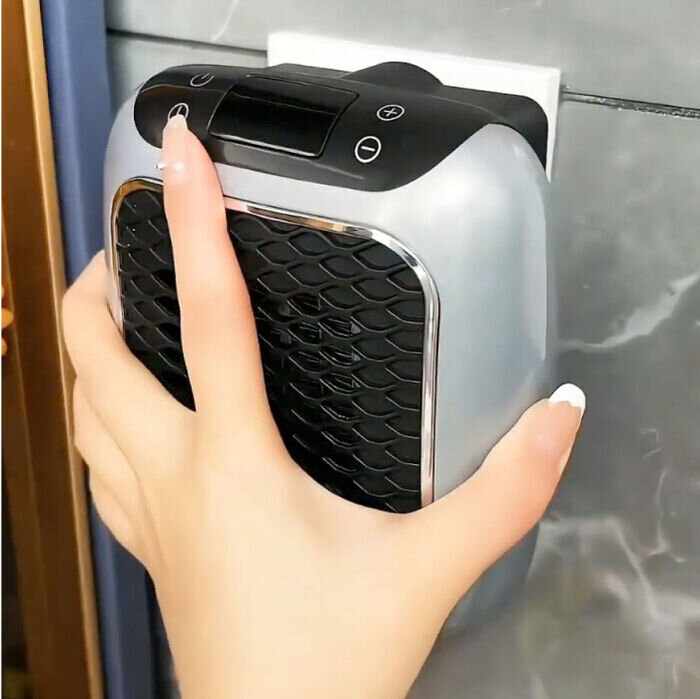
Directly into the wall outlet – never into an extension cord or power strip (vendor image).
“Are space heaters safe?” is one of the most-searched heating questions in the US. A heater is as safe as the way it is used – the WellHeater has overheat protection and auto shut-off according to the vendor; these habits do the rest:
- Read the manual and the rating label first. The product page doesn’t publish technical data, so the label and manual are your reference.
- Plug it directly into a wall outlet. No extension cord, no power strip, no multi-plug adapter – standard advice for every heater.
- Keep the grille free. Never cover it; keep curtains, bedding, clothes, paper and furniture away. An outlet behind the bed or a curtain is the wrong outlet.
- Don’t stack big loads. Don’t run a hair dryer, kettle or second heater from the same outlet at the same time; two WellHeaters belong on different outlets, ideally different circuits.
- Warm up on high, then switch to low. 800 W for a quick boost, 400 W to stay comfortable, door closed.
- Set the thermostat and always the timer. Around 68 °F (20 °C) is a common target for a home office. Per the vendor FAQ, the heater doesn’t switch off at the target temperature – the timer ends the session.
- In the bathroom: only outside the splash zone. Use an outlet well away from tub, shower and sink, never touch the heater with wet hands, keep towels off it and follow the manual.
- Don’t leave it running unattended for long periods. Switch it off when you leave the room for longer, don’t run it overnight while you sleep, and supervise children and pets.
- Switch off, let it cool, unplug by the housing. The grille gets warm in use. Keep grille and filter free of dust as described in the manual.
Who the WellHeater is for – and who should skip it

Warmth where you are sitting: the WellHeater is made for the small spaces you actually use (vendor image).
The WellHeater makes sense for you if:
- You work from home in a small room that is always colder than the rest of the house – and would like to keep the central thermostat lower.
- Your bathroom is cold in the morning and has an outlet well away from water.
- You want a bedroom, guest room or reading corner comfortable for an hour or two.
- You want to bridge the cool weeks of fall and spring before the central heating goes on.
- You rent and can’t install anything, or don’t want a floor heater with a cord in a small room (in dorms and some rentals, check the rules on heaters first).
- You like simple controls: remote, timer and thermostat instead of a single knob.
You can skip it if:
- You want to heat a large living room, an open-plan space or a whole apartment.
- You need total silence for sleeping – any fan heater hums.
- Your only free outlets are next to the sink or tub, or behind furniture or the bed.
- You want certification marks or an IP rating confirmed before buying – the product page doesn’t list them.
- You are actually looking for an air purifier, or a heater for a garage, outdoors or a well pump house.
WellHeater reviews and complaints: what customers report
The product page shows a rating of 4.6/5, states that “94 % of reviewers would recommend” the heater and speaks of “8K+ happy customers” and “1000+ verified reviews”. These figures and the testimonials are vendor-published – we can’t verify them, so we don’t quote individual testimonials. Instead, we compare typical feedback patterns for small plug-in heaters with our own three weeks:
| Typical feedback on plug-in heaters | Does it match our WellHeater test? |
|---|---|
| “Small, no cord, warm at my desk in minutes.” | Yes – the strongest point in the home office. The area around you warms quickly; the whole room takes longer. |
| “The remote and the timer make it practical.” | Yes. With an outlet near the floor, the remote saves bending, and the timer is essential. |
| Complaint: “It doesn’t heat my living room.” | Expected: the vendor states up to 130 sq ft per unit; our 250-sq-ft living room stayed cool beyond the area near the heater. |
| Complaint: “My electric bill didn’t go down.” | Logical if it runs on top of an unchanged central heating schedule. Savings come only from heating less space for fewer hours. |
| Complaint: “The fan is louder than I expected.” | Clearly audible on high, a soft hum on low. Light sleepers use the timer. |
| Complaint: “Return shipping was on me.” | That is what the written return policy says. Keep the original packaging and contact support first. |
One detail from the vendor’s own review section: a published review says the heater switches off at the set temperature, while the vendor FAQ says it doesn’t and recommends the timer – we would go by the FAQ. Otherwise, positive WellHeater reviews match our experience – quick local warmth, easy controls – while typical complaints come from expecting whole-house heating from 800 W. When you read WellHeater reviews online, the most useful ones mention the room size and how the heater was used.
Is WellHeater legit or a scam? Company, checkout and support
Big discount badges lead many shoppers to search for “is WellHeater legit” or “WellHeater scam” before ordering. What we found is a normal direct-to-consumer setup with named companies and written policies:
- Brand site: get-wellheater.com hosts the product pages, shipping policy, return policy, terms and a contact page.
- Seller and checkout: the order is processed on a separate, SSL-secured checkout platform. For US orders this is ShopMinga, operated by Norvello Limited, Lowry Mill, Pendlebury, Swinton, Manchester M27 6DB, United Kingdom – the seller named in the terms on the order page. Payments are processed by that company and appear on your card statement accordingly, so the charge may not say “WellHeater”.
- Payment: card payment – Visa, Mastercard/Maestro, American Express, Discover and others were shown in our checkout.
- Shipping: orders typically processed within 24 hours, tracking e-mail after dispatch, an order tracking page; US delivery 2–12 business days per the shop’s shipping table.
- Guarantee: 30-day money-back guarantee with a written return procedure (see prices section).
- Support: e-mail support@get-wellheater.com and US phone +1 (762) 600-4387; the vendor advertises “24/7 customer support”.
Our order went through like any online purchase: confirmation, tracking, delivery within the stated window, a product that matched the description. We are not aware of a test of the WellHeater by Consumer Reports or another independent consumer organization. In short: WellHeater is a real product sold by named companies with tracking, written policies and reachable support – not a scam. The marketing is enthusiastic; the business behind it is conventional.
Where to buy: Amazon, Walmart, Home Depot or the official website?
“Plug in heater Walmart”, “plug in heater Home Depot” and “Amazon plug in heater” are popular searches, and “plug-in wall heaters as seen on TV” is a search category of its own. WellHeater, however, is sold direct-to-consumer: according to the shop it is available online only, through the official WellHeater website. It isn’t sold through Amazon, and you won’t find it on the shelves at Walmart, Home Depot, Lowe’s or Target. Similar-looking plug-in heaters from other brands exist – they are different products with their own specifications, sellers and return terms. Buying direct means no retail markup, the pack prices (down to $34.37 per unit) are available only there, the 30-day guarantee applies to official-shop orders, and support, tracking and returns run through one channel.
WellHeater price: packs, shipping and the 30-day guarantee
These are the prices in the official checkout in October 2026 for a US delivery address, in US dollars. The shop currently shows reduced prices next to a crossed-out “regular” price – $99.98 for a single unit, for example. What matters is what you actually pay:
| Pack | Price | Per unit | Total incl. $7.95 shipping | Per unit incl. shipping |
|---|---|---|---|---|
| 1 WellHeater (“medium room up to 130 sq ft / 12 m²”) | $49.99 | $49.99 | $57.94 | $57.94 |
| 2 WellHeaters (“large room up to 400 sq ft / 37 m²”) | $89.70 | $44.85 | $97.65 | ≈ $48.83 |
| 3 WellHeaters (“Best seller”, “small apartment up to 600 sq ft / 55 m²”) | $112.47 | $37.49 | $120.42 | $40.14 |
| 4 WellHeaters (“small home up to 800 sq ft / 75 m²”) | $137.48 | $34.37 | $145.43 | ≈ $36.36 |
Shipping is $7.95 on every pack. The order form also offers an optional extended warranty at $4.99 per unit as a tick box; with it, the totals are $62.93, $107.63, $135.39 and $165.39 for one to four units. One-time payment, no subscription. Our recommendation: buy by the number of small rooms, not by the square-footage labels – one unit per office, bathroom or bedroom; the 3- and 4-packs for several cold rooms or for splitting an order with family. With the 30-day guarantee, trying it out carries little risk – just keep the packaging.
- Shipping: processing typically within 24 hours, tracking e-mail, order tracking page; delivery per the shop: US 2–12 business days (Canada 8–12, UK and Europe 7–12).
- 30-day money-back guarantee – how the return works: contact support within 30 days of receiving your order with name, e-mail address, order number and reason. Support typically replies within 3 business days with a return authorization (RMA) and the return address; send the item only there, with the RMA form. Change-of-mind returns must be unused, undamaged and in the original packaging with all accessories. Defective or damaged items are replaced or fully refunded (send photos; report damage on arrival within 48 hours). Return shipping is paid by the customer; the original shipping isn’t refunded. After inspection (up to 7 days) the refund goes to the original payment method; the bank may take another 3–5 business days.
- Support: support@get-wellheater.com, phone +1 (762) 600-4387.
Frequently asked questions about the WellHeater
What do WellHeater reviews and complaints say?
The vendor’s page shows 4.6/5 and “1000+ verified reviews” – vendor-published figures. In our test the WellHeater did well in small rooms: quick local warmth, easy controls, no cable clutter. Typical complaints about plug-in heaters concern large rooms, fan noise on high and return shipping costs.
Is WellHeater legit or a scam?
Legit. The brand site publishes written policies; US orders are processed by ShopMinga, operated by Norvello Limited (Manchester, UK), the seller named in the order page’s terms. Tracking, a 30-day money-back guarantee and support by e-mail and phone are in place, and our order arrived as described.
Does the WellHeater really work?
Yes, for what it is designed for: in our test it made a small home office, bathroom and bedroom comfortable quickly. It isn’t made to heat a large living room or a whole home – the vendor states up to 130 sq ft (12 m²) per unit.
How much electricity does the WellHeater use?
400 W on low and 800 W on high according to the vendor – 0.4 or 0.8 kWh per hour at full power. At an example price of 17 ¢ per kWh, that is about 7 ¢ or 14 ¢ per hour. Use your own price from your bill for an exact figure.
Will a plug-in heater lower my electric bill?
Only if it replaces more expensive heating – for example warming one small room while the central thermostat stays lower. Every electric resistance heater turns about 100 % of its electricity into heat; the “90 % less energy” graphic has no stated reference point.
Can I use the WellHeater as a space heater for the bathroom?
Yes, if the outlet is outside the splash zone and well away from tub, shower and sink. Never touch it with wet hands, keep towels off it and follow the manual. No IP rating is listed on the product page.
Can I plug it into an extension cord or power strip?
No. Plug it directly into a wall outlet – no extension cord, power strip or multi-plug adapter. That is standard safety advice for every heater.
Can I leave it on overnight – does it turn off at the set temperature?
Per the vendor FAQ, it doesn’t switch off when the set temperature is reached; the timer is recommended. The vendor lists overheat protection and an automatic shut-off. Don’t run it unattended for long periods or overnight – set the timer.
Is the WellHeater UL or ETL listed?
The product page doesn’t list certification marks, voltage or an IP rating. Check the rating label and manual on delivery – or ask support before ordering if it matters to you.
Is the WellHeater noisy?
The vendor speaks of a “low, quiet humming sound, similar to brown noise”. On low we found that fair; on high the fan is clearly audible, like a small desk fan.
Is WellHeater sold on Amazon, at Walmart or Home Depot?
No. According to the shop it is available online only, through the official website. The 30-day guarantee applies to orders from the official shop.
What is the WellHeater price?
In the official shop (October 2026): 1 unit $49.99, 2 units $89.70, 3 units $112.47, 4 units $137.48 – plus $7.95 shipping on every pack (totals $57.94, $97.65, $120.42, $145.43). An extended warranty at $4.99 per unit is optional. No subscription.
How does the 30-day money-back guarantee work?
Contact support within 30 days of receiving your order; you get a return authorization and the return address, usually within 3 business days. Change-of-mind returns must be unused and in the original packaging; defective items are replaced or refunded. Return shipping is on you, and the original shipping isn’t refunded.
Has Consumer Reports tested the WellHeater?
We are not aware of any test by Consumer Reports or a comparable independent consumer organization. Our rating is based on our own three-week test and the vendor’s published information.
Our verdict
WellHeater is a well-equipped little plug-in heater that does what a small heater should: it plugs straight into the wall outlet, needs no floor space and no cord, and takes the chill out of a small, closed room quickly. In our test it kept a cold home office comfortable through long workdays – 800 W to warm up, 400 W to stay comfortable – made a chilly bathroom pleasant in the morning and gave the bedroom an hour of warmth in the evening. Remote, touch display and above all the timer make daily use easy. Score 8.0/10 – good.
Being honest: 800 W is small-room heat, not a replacement for central heating, and the savings come from zone heating, not from the efficiency graphics. The timer is essential, there is no published data sheet, and shipping is $7.95 on every pack. Bought for the room you actually sit in and plugged directly into a free wall outlet, the WellHeater is a convenient way to stay warm without heating the whole house – and with 30 days to send it back, the risk is small.
More on heating modes, controls, shipping and returns on the official WellHeater website.
Transparency notice: This article contains affiliate links. If you order through one of these links, we receive a commission – the price for you does not change, and our rating is not influenced by it. Information on power, room size, features, safety functions, the filter and customer ratings comes from the vendor. Safety: plug directly into a wall outlet (no extension cord or power strip), keep the grille free, use in bathrooms only outside the splash zone and never with wet hands, don’t leave it running unattended, use the timer and follow the manual. Electricity costs use an example price of 17 ¢ per kWh. Prices as shown in the vendor’s US shop in October 2026 in US dollars; subject to change.

- WellHeater Reviews 2026: Is This Plug-In Heater Legit – and What Does It Really Cost to Run? - 31. October 2026
- N7 Neo Review (UK 2026): Ingredients, Side Effects – and Does It Really Contain Sildenafil? - 30. October 2026
- MedicGLP Reviews UK 2026: Does Medic GLP Metabolic Balance Work? Legit or Scam, Side Effects & Our Test - 29. October 2026


